MCQ
A particle is moving along a curve. Then
  • A
    if its speed is constant it has no acceleration
  • B
    the direction of its acceleration cannot be along the tangent.
  • C
    if its speed is constant the magnitude of its acceleration is proportional to its curvature.
  • Both $(B)$ and $(C)$

Answer

Correct option: D.
Both $(B)$ and $(C)$
d

Need a full question paper?

Generate a complete, print-ready paper with questions like this in minutes — across 16+ boards, with answer keys.

Start Generating Free

Similar questions

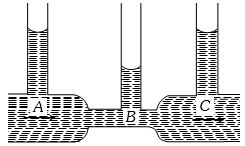
In the following fig. is shown the flow of liquid through a horizontal pipe. Three tubes $A, B$  and $ C$  are connected to the pipe. The radii of the tubes $A, B $ and $C$  at the junction are respectively $ 2 cm, 1 cm$   and $2 cm.$  It can be said that the
The gravitational field due to a mass distribution is $\text{I}=\frac{\text{K}}{\text{r}^3}$ in the X-direction. (K is a constant).Taking the gravitational potential to be zero at infinity, its value at a distance x is:
A thin rod having a length of $1\; m$ and area of cross-section $3 \times 10^{-6}\,m ^2$ is suspended vertically from one end. The rod is cooled from $210^{\circ}\,C$ to $160^{\circ}\,C$. After cooling, a mass $M$ is attached at the lower end of the rod such that the length of rod again becomes $1\,m$. Young's modulus and coefficient of linear expansion of the rod are $2 \times 10^{11} Nm ^{-2}$ and $2 \times 10^{-5} K ^{-1}$, respectively. The value of $M$ is $.......kg .\left(\right.$ Take $\left.g=10\,m s ^{-2}\right)$
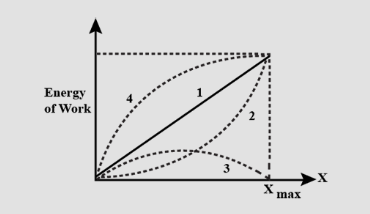
During the displacement, which of the curves shown in the graph best represents the work done on the spring block system by the applied force ?
Velocity of a particle moving along a straight line is given by $v = t^2 -3t -4\,(m/s)$. Find the velocity at the instant when no net force is applicable on particle.......$m/s$
A student attempts to pull himself up by tugging on his hair. He will not succeed
Two identical metal balls at temperature ${200^o}C$and ${400^o}C$ kept in air at ${27^o}C$. The ratio of net heat loss by these bodies is
Let $\mathop A\limits^ \to  $ be a unit vector along the axis of rotation of a purely rotating body and $\mathop B\limits^ \to  $ be a unit vector along the velocity of a particle $ P$ of the body away from the axis. The value of $\mathop A\limits^ \to  .\mathop B\limits^ \to  $ is
An open organ pipe of length L vibrates in its fundamental mode. The pressure variation is maximum.
  1. At the two ends.
  2. At the middle of the pipe.
  3. At distances $\frac{\text{L}}{4}$ inside the ends.
  4. At distances $\frac{\text{L}}{8}$ inside the ends.
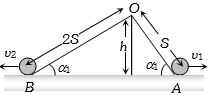
Two uniform similar discs roll down two inclined planes of length $S$ and $2S$ respectively as shown is the fig. The velocities of two discs at the points $A$ and $B$ of the inclined planes are related as