MCQ
A particle is moving along a curve. Then
  • A
    if its speed is constant it has no acceleration
  • B
    the direction of its acceleration cannot be along the tangent.
  • C
    if its speed is constant the magnitude of its acceleration is proportional to its curvature.
  • Both $(B)$ and $(C)$

Answer

Correct option: D.
Both $(B)$ and $(C)$
d

Need a full question paper?

Generate a complete, print-ready paper with questions like this in minutes — across 16+ boards, with answer keys.

Start Generating Free

Similar questions

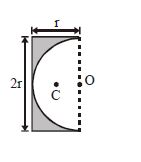
A semicircular portion of radius $'r'$ is cut from a uniform rectangualr plate as shown in figure. The distance of centre of mass $'C'$ of remaining plate, from point $'O'$ is
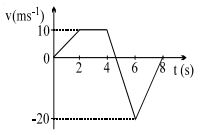
The figure shows a velocity-time graph of a particle moving along a straight line  The maximum displacement of the particle is  ........ $m$
If the molecular weight of two gases are $M_1$ and $ M_1$, then at a temperature the ratio of root mean square velocity $v_1$ and $v_2$ will be
An incompressible fluid flows steadily through a cylindrical pipe which has radius 2R at point A and Radius R at point B farther along the flow direction. If the velocity at point A is v, its velocity at point B is:
The kinetic energy of a body of mass $2 kg $ and momentum of $2 Ns$  is ............. $\mathrm{J}$
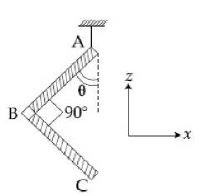
An $L-$ shaped object, made of thin rods of uniform mass density, is suspended with a string as shown in figure. If $AB = BC$, and the angle made by $AB$ with downward vertical is $\theta$ then
A particle is moving on a circular path of radius $r$ with uniform speed $v$. What is the displacement of the particle after it has described an angle of $60^o$ ?
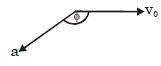
The figure shows the velocity and the acceleration of a point like body at the initial moment of its motion. The direction and the absolute value of the acceleration remain constant. Find the time when the speed becomes minimum.........$s$ (Given : $a = 4\, m/s^2, v_0 = 40\, m/s, \phi =143^o$)
A body starts from rest with uniform acceleration $a,$  its velocity after $n\,seconds$ is $v$. The displacement of the body in last $3\,s$ is : (assume total time of journey from $0$ to $n\,seconds$ )
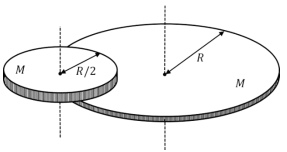
A disc of mass $M$ and radius $R$ is free to rotate about its vertical axis as shown in the figure. A battery operated motor of negligible mass is fixed to this disc at a point on its circumference. Another disc of the same mass $M$ and radius $R / 2$ is fixed to the motor's thin shaft. Initially, both the discs are at rest. The motor is switched on so that the smaller disc rotates at a uniform angular speed $\omega$. If the angular speed at which the large disc rotates is $\omega / n$, then the value of $n$ is. . . . .