MCQ
A particle is moving in a circle with uniform speed. Its motion is
  • A
    Periodic and simple harmonic
  • Periodic but not simple harmonic
  • C
    A periodic
  • D
    None of the above

Answer

Correct option: B.
Periodic but not simple harmonic
b
(b) The motion of particle will and the not be $S H M$ but that of its propotion on a diameter will be period because it has constant speed.

Need a full question paper?

Generate a complete, print-ready paper with questions like this in minutes — across 16+ boards, with answer keys.
Start Generating Free

Similar questions

If $\gamma = 2.5$ and volume is equal to $\frac{1}{8}$ times to the initial volume then pressure $P' $ is equal to (Initial pressure $= P$)
Choose the correct alternative $(s)$
Water from a tap emerges vertically downwards with an initial speed of $1.0\,ms^{-1}.$ The cross-sectional area of the tap is $10^{-4}\,m^2.$ Assume that the pressure is constant throughout the stream of water and that flow is streamlined. The cross-sectional area of the stream, $0.15\,m$ below the tap would be: (take $g = 10\,ms^{-2}$ )
A pendulum of length $2 \; m$ consists of a wooden bob of mass $50 \; g$. A bullet of mass $75 \; g$ is fired towards the stationary bob with a speed $v$. The bullet emerges out of the bob with a speed $\frac{v}{3}$ and the bob just completes the vertical circle. The value of $v$ is $\dots \; ms ^{-1}$. (if $g =10 \; m / s ^{2}$ )
A coin is placed on a horizontal platform which undergoes vertical simple harmonic motion of angular frequency $\omega $. The amplitude of oscillation is gradually increased. The coin will leave contact with the platform for the first time
A car with a vertical windshield moves in a rain storm at a speed of $40 \,km / hr$. The rain drops fall vertically with constant speed of $20 \,m / s$. The angle at which rain drops strike the windshield is .........
A disc of radius $R$ is rolling down an inclined plane whose angle of inclination is $\theta $, Its acceleration would be
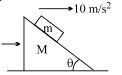
In the figure shown all the surfaces are frictionless, and mass of the block, $m = 1\, kg$. The block and wedge are held initially at rest. Now wedge is given a horizontal acceleration of $10\, m/s^2$ by applying a force on the wedge, so that the block does not slip on the wedge. Then work done by the normal force in ground frame on the block in $\sqrt 3 $ seconds is ......... $J$
A convex lens is made of a material having refractive index 1.2. Both the surfaces of the lens are convex. If it is dipped into water $(\mu=1.33),$ it will behave like:
  1. A convergent lens.
  2. A divergent lens.
  3. A rectangular slab.
  4. A prism.
The maximum velocity at the lowest point, so that the string just slack at the highest point in a vertical circle of radius $l$