MCQ
A particle is moving in a straight line with initial velocity and uniform acceleration $a$. If the sum of the distance travelled in $t^{\text {th }}$ and $( t +1)^{ th }$ seconds is $100 cm$, then its velocity after $t$ seconds, in $.........cm / s$, is
  • A
    $80$
  • $50$
  • C
    $20$
  • D
    $30$

Answer

Correct option: B.
$50$
b
(b) 

Sum of distance travelled in $t^{t h}$ and $(t+1)^{t h}$ seconds is $100 cm$

$u+\frac{a}{2}(2 t-1)+u+\frac{a}{2}(2(t+1)-1)=100$

$2 u+2 a t=100$

$u+a t=100 / 2$

$\Rightarrow v=50 cm / s$

Need a full question paper?

Generate a complete, print-ready paper with questions like this in minutes — across 16+ boards, with answer keys.

Start Generating Free

Similar questions

An object with a mass $10 \,kg$ moves at a constant velocity of $10 \,m/sec$. A constant force then acts for $4\, second$ on the object and gives it a speed of $2\, m/sec$ in opposite direction., the impulse acting on the object is ......... $newton \times \sec $
A bullet of mass $10 \,g$ moving with a speed of $20 \,m / s$ hits an ice block of mass $990 \,g$ kept on a frictionless floor and gets stuck in it. How much ice will melt if $50 \%$ of the lost KE goes to ice is .......... $g$ (initial temperature of the ice block and bullet $=0^{\circ} C$ )
Two bodies of masses m and $2m$ have same momentum. Their respective kinetic energies ${E_1}$ and ${E_2}$ are in the ratio
Two moles of an ideal gas with $\frac{\mathrm{C}_{\mathrm{P}}}{\mathrm{C}_{\mathrm{V}}}=\frac{5}{3}$ are mixed with $3$ moles of another ideal gas with $\frac{\mathrm{C}_{\mathrm{P}}}{\mathrm{C}_{\mathrm{V}}}=\frac{4}{3} .$ The value of $\frac{\mathrm{C}_{\mathrm{P}}}{\mathrm{C}_{\mathrm{V}}}$ for the mixture is
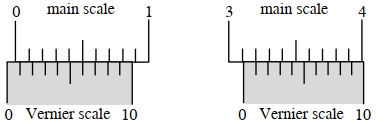
The smallest division on the main scale of a Vernier calipers is $0.1 cm$. Ten divisions of the Vernier scale correspond to nine divisions of the main scale. The figure below on the left shows the reading of this calipers with no gap between its two jaws. The figure on the right shows the reading with a solid sphere held between the jaws. The correct diameter of the sphere is
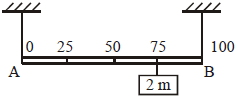
Shown in the figure is rigid and uniform one meter long rod $AB$ held in horizontal position by two strings tied to its ends and attached to the ceiling. The rod is of mass $'m'$ and has another weight of mass $2m$ hung at a distance of $75\, cm$ from $A$. The tension in the string at $A$ is$....mg$
Two bodies of masses $m$ and $4\,m$ are placed at a distance $r$. The gravitational potential at a point on the line joining them where the gravitational field is zero is
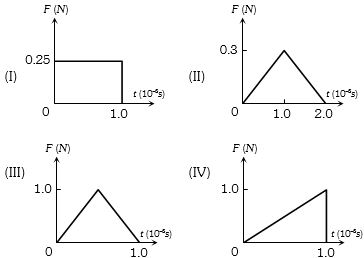
Figures $I, II, III$ and $IV$ depict variation of force with time. The impulse is highest in the case of situations depicted. Figure
An ice cube of dimensions $60\,cm \times 50\,cm \times 20\,cm$ is placed in an insulation box of wall thickness $1\,cm$. The box keeping the ice cube at $0^{\circ}\,C$ of temperature is brought to a room of temperature $40^{\circ}\,C$. The rate of melting of ice is approximately. (Latent heat of fusion of ice is $3.4 \times 10^{5}\,J\,kg ^{-1}$ and thermal conducting of insulation wall is $0.05\,Wm ^{-10} C ^{-1}$ )
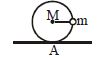
A uniform body of mass $M$  radius $R$ has a small mass $m$ attached at edge as shown in the figure. The system is placed on a perfectly rough horizontal surface such that mass $m$ is at the same horizontal level as the centre of body. It is assumed that there is no slipping at point $A$. If $I_A$ is the moment of the inertia of combined system about point of contact $A$ then the normal reaction at point $A$ just after the system is released from rest is ........ $N$. ($M = 6\ kg$, $m = 2\ kg,$ $I_A = 4\ kg\ m^2$, $R = 1\ m$, $g=10\ m/s^2$)