MCQ
A particle is observed from two frames $S_1$ and. $S_2$. The frame $S_2$ moves with respect to $S_1$ with an acceleration $a$. Let $F_1$ and $F_2$ be the pseudo forces on the particle when seen from $S_1$ and $S_2$ respectively. Which of the following are not possible?
  • A
    $F_1=0, F_2 \neq 0$
  • B
    $F_1 \neq 0, F_2=0$
  • C
    $F_1 \neq 0, F_2 \neq 0$
  • $F_1=0, F_2=0$

Answer

Correct option: D.
$F_1=0, F_2=0$
$\text{a}_{\text{s}_1\text{s}_2}=\text{a} \ ...(1) $
Acceleration of the particle w.r.t. to $\text{S}_1=\frac{\text{F}_1}{\text{m}}$
Acceleration of the particle w.r.t. to $\text{S}_2=\frac{\text{F}_2}{\text{m}}$
If we assume $F_1 = 0$ and $F_2 = 0$,
we can conclude that $\text{a}_{\text{s}_2\text{s}_1}=0 \ ...(2)$
From equations $(1)$ and $(2)$, we can say that our assumption is wrong.
And $F_1 = 0, F_2 = 0$ is not possible.

Need a full question paper?

Generate a complete, print-ready paper with questions like this in minutes — across 16+ boards, with answer keys.

Start Generating Free

Similar questions

A weightless thread can bear tension upto $3.7\, kg wt.$ A stone of mass $500\, gms$ is tied to it and revolved in a circular path of radius $4 m$ in a vertical plane. If $g = 10\,m{s^{ - 2}}$, then the maximum angular velocity of the stone will be ........ $rad/\sec$
‘Parsec’ is the unit of:
A particle executing simple harmonic motion of amplitude $5\, cm$ has maximum speed of $31.4\, cm/s$. The frequency of its oscillation is ..... $Hz$
A car is moving on a circular path of radius $600\,m$ such that the magnitudes of the tangential acceleration and centripetal acceleration are equal. The time taken by the car to complete first quarter of revolution, if it is moving with an initial speed of $54\,km / hr$ is $t \left(1- e ^{-\pi / 2}\right)\,s$. The value of $t$ is $.............$.
$Assertion$ : Radius of gyration of body is a constant quantity.
$Reason$ : The radius of gyration of a body about an axis of rotation may be defined as the root mean square distance of the particle from the axis of rotation
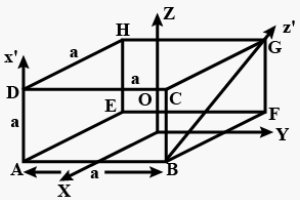
With reference to of a cube of edge a and mass $m,$ state whether the following are true or false. $(O$ is the centre of the cube.$)$
Image
  1. The moment of inertia of cube about $z-$axis is $\text{I}_\text{x}=\text{I}_\text{x}+\text{I}_\text{y}$
  2. The moment of inertia of cube about $z′$ is $\text{I}'_\text{z}=\text{I}_\text{z}+\frac{\text{ma}^2}{2}$
  3. The moment of inertia of cube about $z"$ is $\text{I}{''}_{\text{z}}=\text{I}_2+\frac{\text{ma}^2}{2}$
  4. $\text{I}_\text{x}=\text{I}_\text{y}$
Let $\vec{A}=2 \hat{i}-3 \hat{j}+4 \hat{k}$ and $\vec{B}=4 \hat{i}+j+2 \hat{k}$ then $|\vec{A} \times \vec{B}|$ is equal to ...................
The bob of simple pendulum having length $l$, is displaced from mean position to an angular position $\theta$ with respect to vertical. If it is released, then velocity of bob at lowest position
Two bodies are in equilibrium when suspended in water from the arms of a balance. The mass of one body is $36 g $ and its density is $9 g / cm^3$. If the mass of the other is $48 g$, its density in $g / cm^3$ is
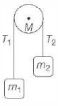
On a pulley of mass $M$ hangs a rope with two masses $m_{1}$ and $m_{2}\left(m_{1} > m_{2}\right)$ tied at the ends as shown in the figure below. The pulley rotates without any friction, whereas the friction between the rope and the pulley is large enough to prevent any slipping. Which of the following plots best represents the difference between the tensions in the rope on the two sides of the pulley as a function of the mass of the pulley?