MCQ
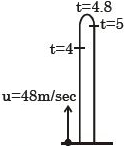
A particle is projected from ground in vertical upward direction at $t = 0$, with initial velocity $48\, m/s$ and the distance travelled by particle in $5^{th}$ second is......$m$ $(g = 10\, m/s^2)$
  • A
    $3$
  • B
    $115$
  • $3.4$
  • D
    $2.8$

Answer

Correct option: C.
$3.4$
c
$5^{\text {th }}$ sec $\Rightarrow t=4 \rightarrow t=5$

$\mathrm{S}_{4 \rightarrow 8}=$ Displacement in last $0.8\, sec$ of upward journey

$\mathrm{S}=\mathrm{vt}-\frac{1}{2} \mathrm{a}_{\mathrm{y}} \mathrm{t}^{2}, \mathrm{v}=0$

Assuming upward direction to be positive $(+i v e)$

$a_y=-g$

$S_{4 \rightarrow 4.8}=\frac{1}{2} \times g \times(0.8)^{2}=5 \times 0.64$

$\begin{aligned} \mathrm{S}_{4.8 \rightarrow 5}=& \mathrm{ut}+\frac{1}{2} \mathrm{at}^{2} \\ &=0+\frac{1}{2} \times 10 \times(0.2)^{2}=5 \times 0.04 \end{aligned}$

$\mathrm{S}_{4 \rightarrow 5}=5 \times 0.68=\frac{17}{5} \mathrm{m}$
Need a full question paper?

Generate a complete, print-ready paper with questions like this in minutes — across 16+ boards, with answer keys.

Start Generating Free

Similar questions

An $npn$ transistor operates as a common emitter amplifier with a power gain of $10^{6} .$ The input circuit resistance is $100\, \Omega$ and the output load resistance is $10\, K \Omega$. The common emitter current gain ' $\beta$ ' will be............. (Round off to the Nearest Integer)
A mixture of two moles of hydrogen and one mole of argon gas is taken in a closed container at room temperature. Consider the following two statements

$(i)$  The average kinetic energy of each molecule of $H_2$ and $Ar$ are the same.

$(ii)$  The partial pressure due to argon gas is more than that due to hydrogen gas
A uniform rope of length $L$ and mass $m_1$ hangs vertically from a rigid support. A block of mass $m_2$ is attached to the free end of the rope. A transverse pulse of wavelength $\lambda _1$, is produced at the lower end of the rope. The wave length of the pulse when it reaches the top of the rope is $\lambda _2$. The ratio $\lambda _2\,/\,\lambda _1$ is 
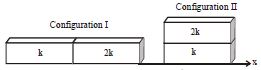
Two rectangular blocks, having identical dimensions, can be arranged either in configuration $I$ or in configuration $II$ as shown in the figure. One of the blocks has thermal conductivity $k$ and the other $2k$. The temperature difference between the ends along the $x-$ axis is the same in both the configurations. It takes $9s$ to transport a certain amount of heat from the hot end to the cold end in the configuration $I$. The time to transport the same amount of heat in the configuration $II$ is .......... $\sec$
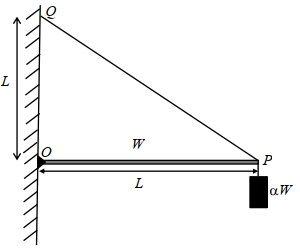
One end of a horizontal uniform beam of weight $W$ and length $L$ is hinged on a vertical wall at point $O$ and its other end is supported by a light inextensible rope. The other end of the rope is fixed at point $Q$, at a height $L$ above the hinge at point $O$. A block of weight $\alpha W$ is attached at the point $P$ of the beam, as shown in the figure (not to scale). The rope can sustain a maximum tension of $(2 \sqrt{2}) W$. Which of the following statement($s$) is(are) correct ?

$(A)$ The vertical component of reaction force at $O$ does not depend on $\alpha$

$(B)$ The horizontal component of reaction force at $O$ is equal to $W$ for $\alpha=0.5$

$(C)$ The tension in the rope is $2 W$ for $\alpha=0.5$

$(D)$ The rope breaks if $\alpha>1.5$
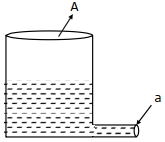
A light cylindrical vessel is kept on a horizontal surface. Area of base is A. A hole of crosssectional area $'a'$ is made just at its bottom side. The minimum coefficient of friction necessary to prevent sliding the vessel due to the impact force of the emerging liquid is $(a\,<\,<\,A)$
A cylinder rolls down two different inclined planes of the same height but of different inclinations
In a hydrogen like atom electron make transition from an energy level with quantum number $n$ to another with quantum number $(n- 1)$. If $n > >  1$, the frequency ofradiation emitted is proportional to
A body takes time $t$ to reach the bottom of an inclined plane of angle $\theta$ with the horizontal. If the plane is made rough, time taken now is $2t$. The coefficient of friction of the rough surface is
At the instant $t = 0$ a force $F = kt$ ( $k$ is a constant) acts on a small body of mass $m$ resting on a smooth horizontal surface. The time, when body leaves the surface is