MCQ
A particle is projected vertically upwards with a speed of $16\  m/s$ , after some time , when it again passes through the point of projection, its speed is found to be $8\  m/s$ . It is known that the work done by air resistance is same during upward and downward motion. Then the maximum height attained by the particle is ...................... $\mathrm{m}$ ( $g$ = $10\  m/s^2$ )
  • $8$
  • B
    $4.8$
  • C
    $17.6$
  • D
    $12.8$

Answer

Correct option: A.
$8$
a
$\mathrm{W}_{\mathrm{s}}+\mathrm{W}_{\mathrm{air}}=\Delta \mathrm{KE}$

during upward

$-m g h-\left(\frac{W_{\text {air }}}{2}\right)=0-\frac{1}{2} m(16)^{2}$

during downward

$+m g h-\left(\frac{W_{\text {air }}}{2}\right)=\frac{1}{2} m(8)^{2}$

subtracting

$2 \mathrm{mgh}=\frac{1}{2} \mathrm{m}\left(8^{2}+16^{2}\right)$

$\mathrm{h}=\frac{64+256}{4 \mathrm{g}}=8$

Need a full question paper?

Generate a complete, print-ready paper with questions like this in minutes — across 16+ boards, with answer keys.

Start Generating Free

Similar questions

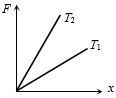
The diagram shows the change $x$ in the length of a thin uniform wire caused by the application of stress $F$ at two different temperatures $T_1$ and $T_2$. The variations shown suggest that
If the mass of the bob in a simple pendulum is increased to thrice its original mass and its length is made half its original length, then the new time period of oscillation is $\frac{x}{2}$ times its original time period. Then the value of $x$ is:
An alpha-particle of mass $m$ suffers $1-$ dimensional elastic collision with a nucleus at rest of unknown mass. It is scattered directly backwards losing, $64\%$ of its initial kinetic energy. The mass of the nucleus is .......... $\mathrm{m}$
A fighter jet is flying horizontally at a certain altitude with a speed of $200 \; ms ^{-1}$. When it passes directly overhead an anti-aircraft gun, bullet is fired from the gun, at an angle $\theta$ with the horizontal, to hit the jet. If the bullet speed is $400 \; m / s$, the value of $\theta$ will be $\dots \; {}^o$
A ball is thrown vertically upwards from the top of a tower at $4.9\,\,m{s^{ - 1}}$. It strikes the pond near the base of the tower after $3 $ seconds. The height of the tower is........$m$
A block of mass $m$ is connected to another block of mass $M$ by a spring (massless) of spring constant $k$. The block are kept on a smooth horizontal plane. Initially the blocks are at rest and the spring is unstretched. Then a constant force $F$ starts acting on the block of mass $M$ to pull it. Find the force of the block of mass $m.$
For an isothermal expansion of a perfect gas, the value of $\frac{{\Delta P}}{P}$ is equal
In a closed organ pipe the frequency of fundamental note is $50 Hz$. The note of which of the following frequencies will not be emitted by it .... $Hz$
Which of the following are obtained by dividing total displacement by total time taken?
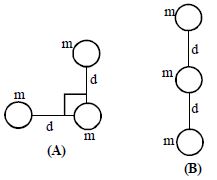
The masses $m$ in fig. $(A)$ and $(B)$ are identical. The gravitational potential energy  in the two cases are $U_A$ and $U_B$. Then