Question
A particle is projected with a speed u at an angle $\theta$ with the horizontal. Consider a small part of its path near the highest position and take it approximately to be a circular arc. What is the radius of this circle? This radius is called the radius of curvature of the curve at the point.

Answer


Particle is projected with speed ‘u’ at an angle $\theta.$ At the highest pt. the vertical component of velocity is‘0’.

So, at that point, velocity $=\text{u}\sin\theta$

centripetal force $=\text{mu}^2\cos^2\Big(\frac{\theta}{\text{r}}\Big)$

At highest pt.

$\text{mg}=\frac{\text{mv}^2}{\text{r}}$

$\Rightarrow\text{r}=\frac{\text{u}^2\cos^2\theta}{\text{g}}$

Need a full question paper?

Generate a complete, print-ready paper with questions like this in minutes — across 16+ boards, with answer keys.

Start Generating Free

Similar questions

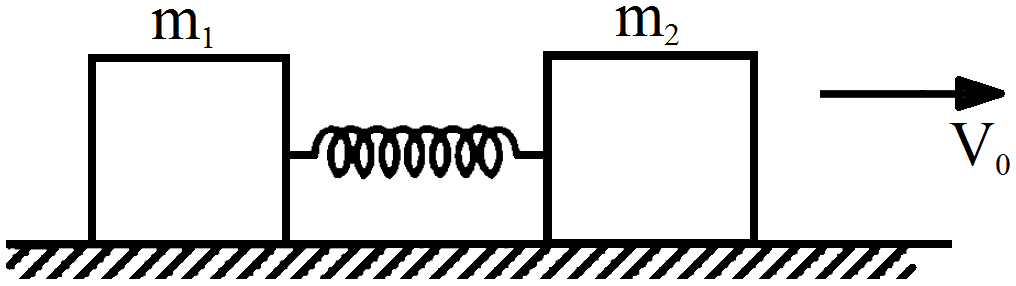
Two blocks of masses m1 and m2 are connected by a spring of spring constant k. The block of mass m2 is given a sharp impulse so that it acquires a velocity v0 towards right. Find
  1. The velocity of the centre of mass.
  2. The maximum elongation that the spring will suffer.
​​​​​​​
A 12.9 eV beam of electrons is used to bombard gaseous hydrogen at room temperature. Upto which energy level the hydrogen atoms would be excited?
Calculate the wavelength of the first member of Paschen series and first member of Balmer series.
A number of identical cells, n, each of emf E, internal resistance r connected in series are charged by a d.c. source of emf E', using a resistor R.
  1. Draw the circuit arrangement.
  2. Deduce the expressions for (a) the charging current and (b) the potential difference across the combination of the cells.
The earth’s surface has a negative surface charge density of 10-9 Cm-2. The potential difference of 400 kV between the top of the atmosphere and the surface results (due to the low conductivity of the lower atmosphere) in a current of only 1800 A over the entire globe. If there were no mechanism of sustaining atmospheric electric field, how much time (roughly) would be required to neutralise the earth’s surface? (This never happens in practice because there is a mechanism to replenish electric charges, namely the continual thunderstorms and lightning in different parts of the globe). (Radius of earth = 6.37 × 106 m.)
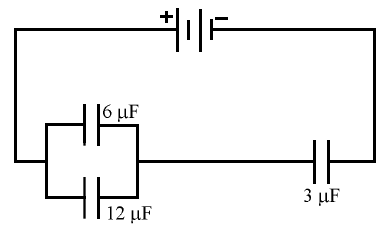
  1. In the following arrangement of capacitors, the energy stored in the 6 μF capacitor is E. Find the value of the following:
  2. Energy stored in 12 μF capacitor.
  3. Energy stored in 3 μF capacitor.
  4. Total energy drawn from the battery.

A body stretches a spring by a particular length at the earth's surface at equator. At what height above the south pole will it stretch the same spring by the same length? Assume the earth to be spherical.
(a) When a telescope is turned upside down and looked at the objective, it appears very small, why?
(b) Why does this not happen in a microscope?
Obtain the equation of electric current for an AC circuit having only inductor.
A healthy youngman standing at a distance of 7m from a 11.8m high building sees a kid slipping from the top floor. With what speed (assumed uniform) should he run to catch the kid at the arms height (1.8m)?
A hollow sphere of radius R lies on a smooth horizontal surface. It is pulled by a horizontal force acting tangentially from the highest point. Find the distance travelled by the sphere during the time it makes one full rotation.