MCQ
A particle is projected with speed $u$ at angle $\theta$ with horizontal from ground. If it is at same height from ground at time $t_1$ and $t_2$, then its average velocity in time interval $t_1$ to $t_2$ is .........
  • A
    Zero
  • B
    $u \sin \theta$
  • $u \cos \theta$
  • D
    $\frac{1}{2}[u \cos \theta]$

Answer

Correct option: C.
$u \cos \theta$
c
(c)

When projectile is at same height, average velocity $=U \cos \theta$.

Need a full question paper?

Generate a complete, print-ready paper with questions like this in minutes — across 16+ boards, with answer keys.

Start Generating Free

Similar questions

Two quantities $A$ and $B$ have different dimensions. Which mathematical operation given below is physically meaningful
A particle moves in the $xy$ plane with a constant acceleration $'g'$ in the negative $y$-direction. Its equation of motion is $y = ax-bx^2$, where $a$ and $b$ are constants. Which of the following are correct?
The main scale of vernier callipers reads in millimetre and its vernier is divided into $8$ divisions, which coincides with $5$ divisions of main scale. When two jaws of instrument touch each other, the zero of the vernier coincides with the zero of main scale. A rod is tightly placed along its length between both jaws. It is observed that the zero of vernier scale lies just left to $36^{th}$ division of main scale and fourth division of vernier scale coincides with the main scale Then the measured value is .......... $cm$
A particle executes linear simple harmonic motion with an ampilitude of $3\,cm$ . When the particle is at $2\,cm$ from the mean position , the magnitude of its velocity is equal to that of its acceleration. Then its time period in seconds is 
A $4 \,kg$ mass and a $1\, kg$ mass are moving with equal kinetic energies. The ratio of the magnitudes of their linear momenta is
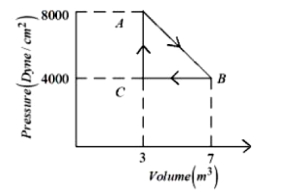
A thermodynamic system is taken from an original state $A$ to an intermediate state $B$ by a linear process as shown in the figure. It's volume is then reduced to the original value from $B$ to $C$ by an isobaric process. The total work done by the gas from $A$ to $B$ and $B$ to $C$ would be :
The stream of a river is flowing with a speed of $2\,km/h.$ A swimmer can swim at a speed of $4\,km/h.$ ....... $^o$ should be the direction of the swimmer with respect to the flow of the river to cross the river straight .
A $90 \mathrm{~kg}$ body placed at $2 \mathrm{R}$ distance from surface of earth experiences gravitational pull of : ( $\mathrm{R}=$ Radius of earth, $\mathrm{g}=10 \mathrm{~ms}^{-2}$ )
The damping force on an oscillator is directly proportional to the velocity.The units of the constant of proportionality are
A spherical solid ball of volume $V$ is made of a material of density $\rho_1$ . It is falling through a liquid of density $\rho_2 (\rho_2 < \rho_1 )$. Assume that the liquid applies a viscous force on the ball that is proportional to the square of its speed $v$, i.e., $F_{viscous}= -kv^2 (k >0 )$,The terminal speed of the ball is