MCQ
A particle is tied to $20\,cm$ long string. It performs circular motion in vertical plane. What is the angular velocity of string when the tension in the string at the top is zero .......... $rad/sec$
  • A
    $5$
  • B
    $2$
  • C
    $7.5$
  • $7$

Answer

Correct option: D.
$7$
d
(d)$\omega = \sqrt {\frac{g}{r}} = \sqrt {\frac{{9.8}}{{0.2}}} = 7\,rad/s$

Need a full question paper?

Generate a complete, print-ready paper with questions like this in minutes — across 16+ boards, with answer keys.
Start Generating Free

Similar questions

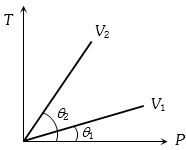
From the following $P-T$ graph what interference can be drawn
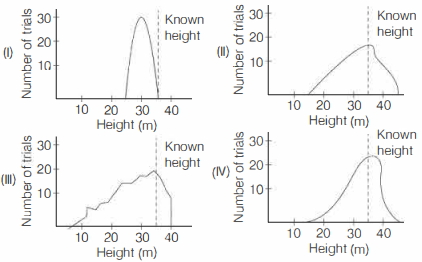
Four students measure the height of a tower. Each student uses a different method and each measures the height many different times. The data for each are plotted below. The measurement with highest precision is
The potential energy of a point particle is given by the expression $V(x)=-\alpha x+\beta \sin (x / \gamma)$. A dimensionless combination of the constants $\alpha, \beta$ and $\gamma$ is
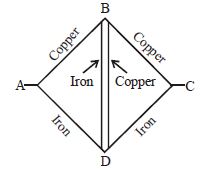
Six wire each of cross-sectional area $A$ and length $l$ are combined as shown in the  figure. The thermal conductivities of copper and iron are $K_1$ and $K_2$ respectively.  The equivalent thermal resistance between points $A$ and $C$ is :-
Take the effect of bulging of earth and its rotation in account. Consider the following statements:
  1. There are points outside the earth where the value of $g$ is equal to its value at the equator.
  2. There are points outside the earth where the value of $g$ is equal to its value at the poles.
A satellite of $10^3 \mathrm{~kg}$ mass is revolving in circular orbit of radius $2 \mathrm{R}$. If $\frac{10^4 \mathrm{R}}{6} \mathrm{~J}$ energy is supplied to the satellite, it would revolve in a new circular orbit of radius:

(use $\mathrm{g}=10 \mathrm{~m} / \mathrm{s}^2, \mathrm{R}=$ radius of earth)
A lead ball moving with a velocity $V$ strikes a wall and stops. If $50\%$ of its energy is converted into heat, then what will be the increase in temperature (Specific heat of lead is $S$)
In equilibrium, the total energy is equally distributed in all possible energy modes having an energy equal to $\text{1/2KB T,}$ this is called as:
If a thermometer reads freezing point of water as $20°C$ and boiling point as $150°C$, how much thermometer read when the actual temperature is $60°C$  .......... $^oC$ 
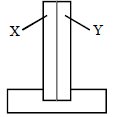
A bimetallic strip consists of metals $X$ and $Y$. It is mounted rigidly at the base as shown. The metal $X$ has a higher coefficient of expansion compared to that for metal $Y$. When the bimetallic strip is placed in a cold bath: