Question
A particle moves on a straight line with a uniform velocity. Its angular momentum:
  1. Is always zero.
  2. Is zero about a point on the straight line.
  3. Is not zero about a point away from the straight line.
  4. About any given point remains constant.
Answer

  1. Is zero about a point on the straight line.
  2. Is not zero about a point away from the straight line.
  3. About any given point remains constant.
Explanation:
  1. Angular momentum $=\text{m}\Big(\overrightarrow{\text{r}}\times\overrightarrow{\text{v}}\Big)$
If the point is on the straight line, $\overrightarrow{\text{r}}$ and $\overrightarrow{\text{v}}$ will have the same direction and their cross product will be zero. Hence, angular momentum is zero.
  1. If the point is not on the straight line, $\overrightarrow{\text{r}}$ and $\overrightarrow{\text{v}}$ will not have the same direction and their cross product will not be zero. Hence, angular momentum is non-zero.
  2. No external torque is applied on the body; therefore, its angular momentum about any given point remains constant.

Need a full question paper?

Generate a complete, print-ready paper with questions like this in minutes — across 16+ boards, with answer keys.

Start Generating Free

Similar questions

A parallel plate capacitor is made by stacking n equally spaced plates connected alternately. If the capacitance between any two plates is  C then the resultant capacitance is(a) C(b) nC (c) (n – 1)C(d) (n + 1)C
       
What happens when some charge is placed on a soap bubble?
When the separation between two charges is increased the electric potential energy of the charges.
Select the correct statements. Coulomb’s law correctly describes the electric force that:
i. binds the electrons of an atom to its nucleus.
ii. binds the protons and neutrons in the nucleus of an atom.
iii. binds atoms together to form molecules.
What is the dielectric constant of a metal?
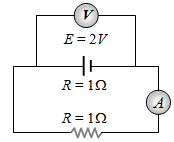
Assertion : In the following circuit $emf$ is $2V$ and internal resistance of the cell is $1 W$ and $R = 1W,$ then reading of the voltmeter is $1V$.

Reason : $V = E - ir$ where $E = 2V, i = \frac{2}{2} = 1A$ and $R = 1 W$
The power rating of an electric motor which draws a current  of 3.75 amperes when operated at 200 V is about(a) 1 H.P.(b) 500 W(c) 54 W  (d) 750 H.P.
       
A person travelling on a straight line moves with a uniform velocity $v_1$ for some time and with uniform velocity $v_2$ for the next equal time. The average velocity is given by:
A hydrogen atom (ionisation potential 13.6 eV) makes a transition from third excited state to first excited state. The energy of the photon emitted in the process is(a) 1.89 eV(b) 2.55 eV(c) 12.09 eV(d) 12.75 eV
       
Assertion :   The stars twinkle while the planets do not.
Reason     :  The stars are much bigger in size than the planets.(a) If both assertion and reason are true and the reason is the correct explanation of the assertion.(b) If both assertion and reason are true but reason is not the correct explanation of the assertion.(c) If assertion is true but reason is false.(d) If the assertion and reason both are false.