- Is zero.
- Remains constant.
- Goes on Increasing.
- Goes on decreasing.
Explanation:
For angular momentum. we have:
$\overrightarrow{\text{L}}=\text{m}\Big(\overrightarrow{\text{r}}\times\overrightarrow{\text{v}}\Big)$
$\overrightarrow{\text{v}}=\text{v}\hat{\text{i}}$ and $\overrightarrow{\text{r}}=\text{x}\hat{\text{i}}+\text{y}\hat{\text{j}}$
So, $\overrightarrow{\text{L}}=-\text{mvy}\hat{\text{k}}$
m, v and y are constant; therefore, angular momentum remains constant.
Generate a complete, print-ready paper with questions like this in minutes — across 16+ boards, with answer keys.
At sun rise or sunset, the sun looks more red than at mid-day because
|
(a) The sun is hottest at these times |
(b) Of the scattering of light |
|
(c) Of the effects of refraction |
(d) Of the effects of diffraction |
The chemical equivalent of copper and zinc are 32 and 108 respectively. When copper and silver voltameter are connected in series and electric current is passed through for sometimes, 1.6 g of copper is deposited. Then, the mass of silver deposited will be
|
(a) 3.5 g |
(b) 2.8 g |
(c) 5.4 g |
(d) None of these |
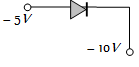
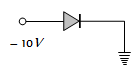
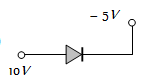
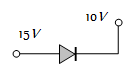
Which one is reverse-biased
|
(a)
|
(b)
|
(c)
|
(d)
|
A particle of charge +q and mass m moving under the influence of a uniform electric field and a uniform magnetic field
follows trajectory from P to Q as shown in figure. The velocities at P and Q are v
and -2v
respectively. Which of the following statement(s) is/are correct
|
(a) E = |
|
(b) Rate of work done by electric field at P is |
|
(c) Rate of work done by both the fields at Q is zero |
|
(d) a, b, c |