MCQ
A particle moving with uniform speed in a circular path maintains:
  • A
    Constant acceleration
  • B
    Constant velocity but varying acceleration
  • Varying velocity and varying acceleration
  • D
    Constant velocity

Answer

Correct option: C.
Varying velocity and varying acceleration
c
A particle moving with uniform speed in a circular path maintains varying velocity and varying acceleration. It is because direction of both velocity as well as acceleration will change continuously.

Need a full question paper?

Generate a complete, print-ready paper with questions like this in minutes — across 16+ boards, with answer keys.
Start Generating Free

Similar questions

In a capillary rise experiment, the water level rises to a height of $5\, cm$. If the same capillary tube is placed in water such that only $3\, cm$ of the tube projects outside the water level, then
The figure shows a tetrahedron, each side of which has a resistance $r$ Choose the correct statement $(s)$ related to the resistance between any two points.
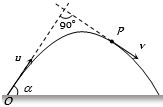
A body is projected with velocity $u$ making an angle $\alpha$ with the horizontal. Its velocity when it is perpendicular to the initial velocity vector $u$ is
A particle is executing $SHM$ of amplitude $A,$ about the mean position $x = 0.$ Which of the following cannot be a possible phase difference between the positions of the particle at $x = +\,A/2$ and $x = - A/\sqrt {2} .$
An electron makes a transition from orbit $n = 4$ to the orbit $n = 2$ of a hydrogen atom. The wave number of the emitted radiations ($R =$ Rydberg's constant) will be
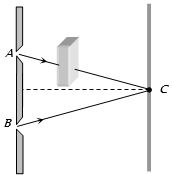
In Young’s experiment, monochromatic light is used to illuminate the two slits $A$ and $B. $ Interference fringes are observed on a screen placed in front of the slits. Now if a thin glass plate is placed normally in the path of the beam coming from the slit
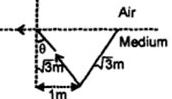
refractive index of medium is
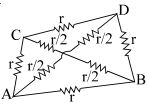
The given electrical network is equivalent to
For $CE$ transistor amplifier, the audio signal voltage across the collector  resistance of $2 \,\,k\Omega$ is $4\,\, V.$ If the current amplification factor of the transistor is $100$ and the base resistance is $1  \,\,k\Omega$, then the input signal voltage is.......$mV$
Image
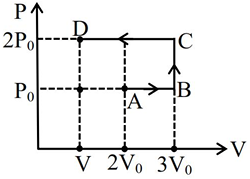
Using the given P-V diagram, the work done by an ideal gas along the path ABCD is -