A particle of mass $10$ grams is executing simple harmonic motion with an amplitude of $0.5\, m$ and periodic time of $(\pi /5)$ seconds. The maximum value of the force acting on the particle is ... $N$
Medium
Download our app for free and get started
(d) Maximum force $ = m(a{\omega ^2}) = ma\left( {\frac{{4{\pi ^2}}}{{{T^2}}}} \right)$
$ = 0.5\,\left( {\frac{{4{\pi ^2}}}{{{\pi ^2}/25}}} \right) \times 0.01 = 0.5N$
$ = 0.5\,\left( {\frac{{4{\pi ^2}}}{{{\pi ^2}/25}}} \right) \times 0.01 = 0.5N$

Download our appand get started for free
Experience the future of education. Simply download our apps or reach out to us for more information. Let's shape the future of learning together!No signup needed.*
Similar Questions
- 1Force constant of a spring is $K$ . If half part is detached then force constant of the remaining spring will beView Solution
- 2A plank with a small block on top of it is under going vertical $SHM$ . Its period is $2\ sec$ . The minimum amplitude at which the block will separate from plank isView Solution
- 3The displacement $y(t) = A\,\sin \,(\omega t + \phi )$ of a pendulum for $\phi = \frac {2\pi }{3}$ is correctly represented byView Solution
- 4A pendulum has time period $T$ in air. When it is made to oscillate in water, it acquired a time period $T' = \sqrt 2 T$. The density of the pendulum bob is equal to (density of water $= 1$)View Solution
- 5silver atom in a solid oscillates in simple harmonic motion in some direction with a frequency of $10^{12} /sec$. What is the force constant of the bonds connecting one atom with the other? ................ $\mathrm{N/m}$ (Mole wt. of silver $= 108 $ andAvagadro number $= 6.02 \times 10^{23}$ $gm \ mole^{ -1}$ )View Solution
- 6In damped oscillations, damping force is directly proportional to speed of oscillator. If amplitude becomes half of its maximum value in $1 \,s$, then after $2 \,s$ amplitude will be $\left(A_0-\right.$ initial amplitude)View Solution
- 7A large horizontal surface moves up and down in $S.H.M.$ with an amplitude of $1\, cm$. If a mass of $10\, kg$ (which is placed on the surface is to remain continuously in contact with it, the maximum frequency of $S.H.M.$ will be .... $Hz$View Solution
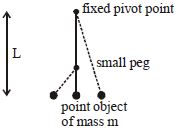
- 8A simple pendulum of length $L$ is constructed from a point object of mass $m$ suspended by a massless string attached to a fixed pivot point. $A$ small peg is placed a distance $2L/3$ directly below the fixed pivot point so that the pendulum would swing as shown in the figure below. The mass is displaced $5$ degrees from the vertical and released. How long does it take to return to its starting position?View Solution
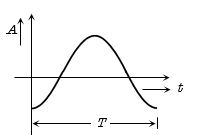
- 9Acceleration $A$ and time period $T$ of a body in $S.H.M.$ is given by a curve shown below. Then corresponding graph, between kinetic energy $(K.E.)$ and time $t$ is correctly represented byView Solution
- 10The $S.H.M.$ of a particle is given by the equations $=2 \sin \omega t+4 \cos \omega t$. Its amplitude of oscillation is ........ unitsView Solution