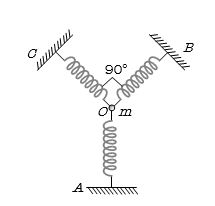
A particle of mass $m$ is attached to three identical springs $A, B$ and $C$ each of force constant $ k$ a shown in figure. If the particle of mass $m$ is pushed slightly against the spring $A$ and released then the time period of oscillations is
Diffcult
Download our app for free and get started
(b) When the particle of mass $m$ at $O$ is pushed by $y$ in the direction of $A$ The spring $A$ will be compressed by $y$ while spring $B$ and $C$ will be stretched by $y' = y\cos 45^\circ .$ So that the total restoring force on the mass $m $ along $ OA.$
${F_{net}} = {F_A} + {F_B}\cos 45^\circ + {F_C}\cos 45^\circ $
$ = ky + 2ky'\cos 45^\circ $$ = ky + 2k(y\cos 45^\circ )\cos 45^\circ $$ = 2ky$
Also ${F_{net}} = k'y$ ==> $k'y = 2ky$==> $k' = 2k$
$T = 2\pi \sqrt {\frac{m}{{k'}}} = 2\pi \sqrt {\frac{m}{{2k}}} $
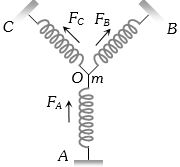
${F_{net}} = {F_A} + {F_B}\cos 45^\circ + {F_C}\cos 45^\circ $
$ = ky + 2ky'\cos 45^\circ $$ = ky + 2k(y\cos 45^\circ )\cos 45^\circ $$ = 2ky$
Also ${F_{net}} = k'y$ ==> $k'y = 2ky$==> $k' = 2k$
$T = 2\pi \sqrt {\frac{m}{{k'}}} = 2\pi \sqrt {\frac{m}{{2k}}} $

Download our appand get started for free
Experience the future of education. Simply download our apps or reach out to us for more information. Let's shape the future of learning together!No signup needed.*
Similar Questions
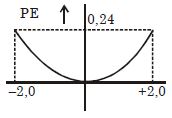
- 1A particle executing $S.H.M.$ its potential energy $V/S$ displacement graph is given by The value of restoring force constant is ..... $N/m$View Solution
- 2The equation of a particle executing simple harmonic motion is given by $x =\sin \pi\left( t +\frac{1}{3}\right) m$. At $t =1 \,s$, the speed of particle will be .......... $cm s ^{-1}$ (Given : $\pi=3.14$ )View Solution
- 3The force constants of two springs are ${K_1}$ and ${K_2}$. Both are stretched till their elastic energies are equal. If the stretching forces are ${F_1}$ and ${F_2}$, then ${F_1}:{F_2}$ isView Solution
- 4The displacement of a particle along the $x-$ axis is given by $x=asin^2$$\omega t$ . The motion of the particle corresponds toView Solution
- 5The phase of a particle executing simple harmonic motion is $\frac{\pi }{2}$ when it hasView Solution
- 6The displacement of a particle moving in $S.H.M.$ at any instant is given by $y = a\sin \omega t$. The acceleration after time $t = \frac{T}{4}$ is (where $T$ is the time period)View Solution
- 7For a particle executing simple harmonic motion, the kinetic energy $K$ is given by $K = {K_o}{\cos ^2}\omega t$. The maximum value of potential energy isView Solution
- 8The acceleration of a particle performing S.H.M. is at a distance of $3\; cm$ from the mean position is $ 12\,cm/sec^2 $. Its time period is ..... $\sec$View Solution
- 9The angular velocity and the amplitude of a simple pendulum is $\omega $ and $a$ respectively. At a displacement $X$ from the mean position if its kinetic energy is $T$ and potential energy is $V$, then the ratio of $T$ to $V$ isView Solution
- 10The kinetic energy and potential energy of a particle executing simple harmonic motion will be equal, when displacement (amplitude = $a$) isView Solution