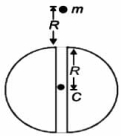
A particle of mass $m$ is dropped from a height $R$ equal to the radius of the earth above the tunnel dug through the earth as shown in the figure. Hence the correct statement is
Diffcult
Download our app for free and get started
(d)
When the particle is outside the tunnel force acting on it is $\propto \frac{1}{r^2}$ where, $r$ is the distance from the centre of the earth.
When the particle is inside the tunnel force acting on it is $\propto \frac{1}{r}$ where, $r$ is the distance from the centre of the earth.
In both cases, force is always directed towards the centre of the earth.
Thus motion is oscillatory and also periodic but not $SHM$.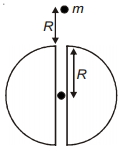

Download our appand get started for free
Experience the future of education. Simply download our apps or reach out to us for more information. Let's shape the future of learning together!No signup needed.*
Similar Questions
- 1A body executes sample harmonic motion under the action of a force $F_1$ with a time period $(4 / 5)\ sec$. If the force is changed to $F_ 2$ it executes $SHM$ with time period $(3 / 5)\ sec$. If both the forces $F_1$ and $F_2$ act simultaneously in the same direction on the body, it's time period (in $second$) isView Solution
- 2Two simple harmonic motions, as shown, are at right angles. They are combined to form Lissajous figuresView Solution
$x\left( t \right) = A\,\sin \,\left( {at + \delta } \right)$
$y\left( t \right) = B\,\sin \,\left( {bt} \right)$
Identify the correct match below
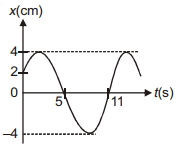
- 3Figure shows the position-time graph of an object in $S.H.M.$ The correct equation representing this motion is ..........View Solution
- 4Two particles oscillating in $SHM$ along two very close parallel path such that they have same mean position. The equation of $SHM$ of two particles are $x_1 = A\, sin\,\omega t$ and $x_2 = A\,sin(\omega t + \phi )$ respectively. If maximum distance between them is $\frac{6A}{5}$ then $\phi $ equal to ..... $^o$View Solution
- 5Two particles $P$ and $Q$ describe simple harmonic motions of same period, same amplitude, along the same line about the same equilibrium position $O.$ When $P$ and $Q$ are on opposite sides of $O$ at the same distance from $O$ they have the same speed of $1.2 \,m/s$ in the same direction, when their displacements are the same they have the same speed of $1.6\, m/s$ in opposite directions. The maximum velocity in $m/s$ of either particle isView Solution
- 6A particle of mass $10\, gm$ is describing $S.H.M.$ along a straight line with period of $2\, sec$ and amplitude of $10, cm$. Its kinetic energy when it is at $5 \,cm$ from its equilibrium position isView Solution
- 7A particle is performing simple harmonic motion along $x-$axis with amplitude $4 \,cm$ and time period $1.2\, sec$. The minimum time taken by the particle to move from $x =2 ,cm$ to $ x = + 4\, cm$ and back again is given by .... $\sec$View Solution
- 8A particle has simple harmonic motion. The equation of its motion is $x = 5\sin \left( {4t - \frac{\pi }{6}} \right)$, where $x$ is its displacement. If the displacement of the particle is $3$ units, then it velocity isView Solution
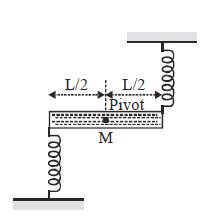
- 9A uniform stick of mass $M$ and length $L$ is pivoted at its centre. Its ends are tied to two springs each of force constant $K$ . In the position shown in figure, the strings are in their natural length. When the stick is displaced through a small angle $\theta $ and released. The stickView Solution
- 10A bob of mass $'m'$ suspended by a thread of length $l$ undergoes simple harmonic oscillations with time period ${T}$. If the bob is immersed in a liquid that has density $\frac{1}{4}$ times that of the bob and the length of the thread is increased by $1 / 3^{\text {rd }}$ of the original length, then the time period of the simple harmonic oscillations will be :-View Solution