Question
A particle of mass m, just completes the vertical circular motion. Derive the expression for the difference in tensions at the highest and the lowest points
Answer

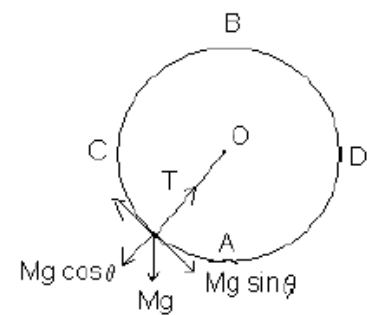
Consider a body of mass ' $M$ ' moving in a vertical circle of radius ' $R$ '. At any position $P$, the forces are acting body are weight Mg vertically downward and tension ' $T$ ' towards centre. Centripetal force $F _{ C }= T - Mg \cos \theta$
$T=FC+Mg \cos \theta$
Image
The body is moving such that it can move in a vertical circle.
At position \(B : \theta=180^{\circ}, \cos \theta=-1 . T_B=F_C-M g\)
\(\therefore T_B=\frac{M V_B^2}{R}-M g\)
\(\therefore T_B=\frac{M g R}{R}-M g\)
\(\therefore T_B=0\)
At position A : \(\theta=0^{\circ}, \cos \theta=1, T_B=F_C-M g\)
\(T_A=F_C+M g\)
\(\therefore T_A=\frac{M V_A^2}{R}+M g\)
\(\therefore T_A=\frac{5 M g R}{R}+M g\)
\(\therefore T_A=6 M g\)
Difference in tension \(T_B-T_A=6 Mg\)

Need a full question paper?

Generate a complete, print-ready paper with questions like this in minutes — across 16+ boards, with answer keys.

Start Generating Free

Similar questions

A stone of mass $100 \mathrm{~g}$ attached to a string of length $50 \mathrm{~cm}$ is whirled in a vertical circle by giving it a velocity of $7 \mathrm{~m} / \mathrm{s}$ at the lowest point. Find the velocity at the highest point.
State Bernoulli's principle.
An alpha particle (the nucleus of helium atom) (with charge $+2e$) is accelerated and moves in a vacuum tube with kinetic energy $= 10.00\ MeV.$ On applying a transverse a uniform magnetic field of $1.851\ T,$ it follows a circular trajectory of radius $24.60\ cm.$ Obtain the mass of the alpha particle. [charge of electron $= 1.62 \times 10^{-19} C$]
Find the kinetic energy per molecule of a diatomic gas at $300 \mathrm{~K}$.
The fundamental frequency of an air column in a pipe closed at one end is in unison with the third overtone of an open pipe. Calculate the ratio of the lengths of their air columns.
A body cools from \(80^{\circ} C\) to \(70^{\circ} C\) in 5 minutes and to \(62^{\circ} C\) in the next $5$ minutes. Calculate the temperature the surroundings.
Find the kinetic energy per unit volume of nitrogen at a pressure of $76 \mathrm{~cm}$ of mercury. Hence, find the kinetic energy of $10 \mathrm{~cm}^3$ of the gas under the same condition. Take $\rho$ (mercury) = $13.6 \mathrm{~g} / \mathrm{cm}^3$ and $\mathrm{g}=9.8 \mathrm{~m} / \mathrm{s}^2$.
Find the relative permeability, if the permeability of metal is $0.1256 TmA^{-1}$
Two parallel plate capacitors X and Y have the same area of the plates and the same separation between them is connected in series to a battery of 15 V. X has air between the plates while Y contains a dielectric of constant k = 2.
i) Calculate the capacitance of each capacitor if the equivalent capacitance of the combination is 2 μF.
ii) Calculate the potential difference between the plates of X and Y.
iii) What is the ratio of the electrostatic energy stored in X and Y?
Calculate the time taken by a body performing SHM of period 2 seconds to cover half the amplitude starting from an extreme position.