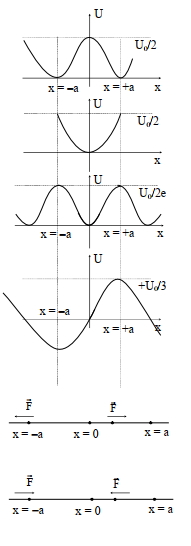
A particle of unit mass is moving along the $x$-axis under the influence of a force and its total energy is conserved. Four possible forms of the potential energy of the particle are given in column $I$ (a and $U _0$ are constants). Match the potential energies in column $I$ to the corresponding statement$(s)$ in column $II.$
| column $I$ | column $II$ |
| $(A)$ $U _1( x )=\frac{ U _0}{2}\left[1-\left(\frac{ x }{ a }\right)^2\right]^2$ | $(P)$ The force acting on the particle is zero at $x = a$. |
| $(B)$ $U _2( x )=\frac{ U _0}{2}\left(\frac{ x }{ a }\right)^2$ | $(Q)$ The force acting on the particle is zero at $x=0$. |
| $(C)$ $U _3( x )=\frac{ U _0}{2}\left(\frac{ x }{ a }\right)^2 \exp \left[-\left(\frac{ x }{ a }\right)^2\right]$ | $(R)$ The force acting on the particle is zero at $x =- a$. |
| $(D)$ $U _4( x )=\frac{ U _0}{2}\left[\frac{ x }{ a }-\frac{1}{3}\left(\frac{ x }{ a }\right)^3\right]$ | $(S)$ The particle experiences an attractive force towards $x =0$ in the region $| x |< a$. |
| $(T)$ The particle with total energy $\frac{ U _0}{4}$ can oscillate about the point $x=-a$. |
IIT 2015, Diffcult


Download our appand get started for free
Experience the future of education. Simply download our apps or reach out to us for more information. Let's shape the future of learning together!No signup needed.*
Similar Questions
- 1The equation of a particle executing simple harmonic motion is given by $x =\sin \pi\left( t +\frac{1}{3}\right) m$. At $t =1 \,s$, the speed of particle will be .......... $cm s ^{-1}$ (Given : $\pi=3.14$ )View Solution
- 2In an elevator, a spring clock of time period $T_S$ (mass attached to a spring) and a pendulum clock of time period $T_P$ are kept. If the elevator accelerates upwardsView Solution
- 3The amplitude of an oscillating simple pendulum is $10\,cm$ and its period is $4\, sec$. Its speed after $1\, sec$ after it passes its equilibrium position, is ... $m/s$View Solution
- 4A particle is executing simple harmonic motion $(SHM)$ of amplitude $A,$ along the $x-$ axis, about $x = 0.$ When its potential energy $(PE)$ equals kinetic energy $(KE),$ the position of the particle will beView Solution
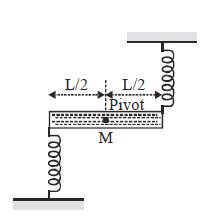
- 5A uniform stick of mass $M$ and length $L$ is pivoted at its centre. Its ends are tied to two springs each of force constant $K$ . In the position shown in figure, the strings are in their natural length. When the stick is displaced through a small angle $\theta $ and released. The stickView Solution
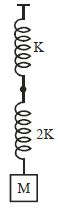
- 6Two springs of force constant $K$ and $2K$ are connected to a mass as shown below. The frequency of oscillation of the mass isView Solution
- 7The motion of a simple pendulum excuting $S.H.M$. is represented by following equation.View Solution
$Y = A \sin (\pi t +\phi)$, where time is measured in $second$.
The length of pendulum is .............$cm$
- 8View SolutionIdentify the correct statement
- 9View SolutionA particle executes SHM of amplitude A. The distance from the mean position when its's kinetic energy becomes equal to its potential energy is on
- 10A particle of mass $m$ in a unidirectional potential field have potential energy $U(x)=\alpha+2 \beta x^2$, where $\alpha$ and $\beta$ are positive constants. Find its time period of oscillation.View Solution