MCQ
A particle revolves round a circular path. The acceleration of the particle is
  • A
    Along the circumference of the circle
  • B
    Along the tangent
  • Along the radius
  • D
    Zero

Answer

Correct option: C.
Along the radius
c
Along the radius directed towards the centre.

Need a full question paper?

Generate a complete, print-ready paper with questions like this in minutes — across 16+ boards, with answer keys.
Start Generating Free

Similar questions

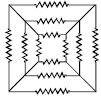
Twelve resistors each of resistance $16 \,\Omega $ are connected in the circuit as shown. The net resistance between $AB$ (any two conjugate points of outer square) is ............... $\Omega$
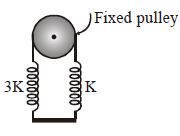
A bar of mass $m$ is suspended horizontally on two vertical springs of spring constant $k$ and $3k$ . The bar bounces up and down while remaining horizontal. Find the time period of oscillation of the bar (Neglect mass of springs and friction everywhere).
A common example of alpha decay is ${ }_{82}^{238} U \longrightarrow{ }_{80}^{234} Th +{ }_2 He ^4+ Q$.  ( Given : ${ }_{92}^{238} U =238.05060 u ,$ ${ }_{90}^{234} Th =234.04360 u ,$ ${ }_2^4 He =4.00260 u \text {, and }$ $1 u =931.5 \frac{ MeV }{ c ^2} )$. The energy released $(Q)$ during the alpha decay of ${ }_{92}^{238} U$ is $......\,MeV$
Two identical metallic spheres $A$ and $B$ when placed at certain distance in air repel each other with a force of $F$. Another identical uncharged sphere $C$ is first placed in contact with $A$ and then in contact with $B$ and finally placed at midpoint between spheres $A$ and $B$. The force experienced by sphere $C$ will be.
$N$ identical spherical drops charged to the same potential $V$ are combined to form a big drop. The potential of the new drop will be
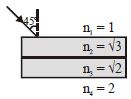
In the figure shown the angle made by the light ray with the normal in the medium of refractive index $\sqrt 2$ is.....$^o$
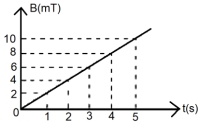
The magnetic field $B$ crossing normally a square metallic plate of area $4\,m ^2$ is changing with time as shown in figure. The magnitude of induced $emf$ in the plate during $t=2\,s$ to $t=4\,s$, is $..........\,mV$
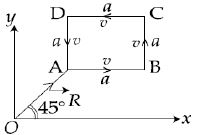
A particle of mass $m$ is moving along the side of a square of side '$a$', with a uniform speed $v$ in the $x-y$ plane as shown in the figure

Which of the following statement is false for the angular momentum $\vec L$ about the origin ?
The Truth table  given in fig. represents
$A$ $B$ $Y$
$0$ $0$ $0$
$0$ $1$ $1$
$1$ $0$ $1$
$1$ $1$ $1$
Two forces are such that the sum of their magnitudes is $18\; N$ and their resultant is $12\; N$ which is perpendicular to the smaller force. Then the magnitudes of the forces are