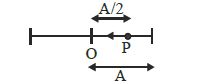
A particle starts from a point $P$ at a distance of $A/2$ from the mean position $O$ and travels towards left as shown in the figure. If the time period of $SHM$ , executed about $O$ is $T$ and amplitude $A$ then the equation of motion of particle is
Medium
Download our app for free and get started
$\mathrm{x}=\mathrm{A} \sin \left(\omega \mathrm{t}+\frac{\pi}{2}+\frac{\pi}{3}\right)$
$\mathrm{x}=\mathrm{A} \sin \left(\omega \mathrm{t}+\frac{5 \pi}{6}\right)=\mathrm{A} \sin \left(\frac{2 \mathrm{n}}{\mathrm{T}} \mathrm{t}+\frac{5 \mathrm{n}}{6}\right)$

Download our appand get started for free
Experience the future of education. Simply download our apps or reach out to us for more information. Let's shape the future of learning together!No signup needed.*
Similar Questions
- 1$Assertion :$ In simple harmonic motion, the motion is to and fro and periodicView Solution
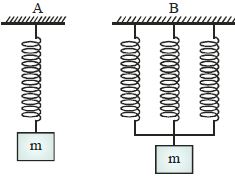
$Reason :$ Velocity of the particle $(v) = \omega \sqrt {k^2 - x^2}$ (where $x$ is the displacement). - 2The springs in figure. $A$ and $B$ are identical but length in $A$ is three times that in $B$. The ratio of period $T_A/T_B$ isView Solution
- 3The displacement of a particle executing SHM is given by $x=10 \sin \left(\omega t+\frac{\pi}{3}\right) \mathrm{m}$. The time period of motion is $3.14 \mathrm{~s}$. The velocity of the particle at $\mathrm{t}=0$is_________. $\mathrm{m} / \mathrm{s}$.View Solution
- 4The instantaneous displacement of a simple pendulum oscillator is given by $x = A\cos \left( {\omega t + \frac{\pi }{4}} \right)$. Its speed will be maximum at timeView Solution
- 5A particle executes $SHM$ on a straight line path. The amplitude of oscillation is $2\, cm.$ When the displacement of the particle from the mean position is $1\, cm,$ the numerical value of magnitude of acceleration is equal to the numerical value of magnitude of velocity. The frequency of $SHM$ (in $second^{-1}$) is :View Solution
- 6The distance covered by a particle undergoing $SHM$ in one time period is (amplitude $= A$)View Solution
- 7View SolutionTo make the frequency double of a spring oscillator, we have to
- 8The displacement of a particle executing $S.H.M.$ is given by $x=0.01 \sin 100 \pi(t+0.05)$. The time period is ........ $s$View Solution
- 9If displacement $x$ and velocity $v$ are related as $4v^2 = 16\, -\, x^2$ in a $SHM$ . Then time period of given $SHM$ is (consider $SI\,units$ )View Solution
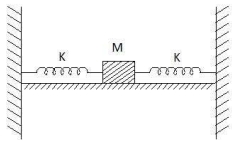
- 10In the figure given below. a block of mass $M =490\,g$ placed on a frictionless table is connected with two springs having same spring constant $\left( K =2 N m ^{-1}\right)$. If the block is horizontally displaced through ' $X$ 'm then the number of complete oscillations it will make in $14 \pi$ seconds will be $.........$View Solution