MCQ
A particle stays at rest as seen in a frame. We can conclude that,
  • A
    The frame is inertial.
  • B
    The frame may be non$-$inertial but there is a non zero resultant force.
  • C
    The frame may be inertial but resultant force on the particle is zero. 
  • $B$ and $C$

Answer

Correct option: D.
$B$ and $C$

Particle will be seen at rest only when frame is inertial and resultant force on particle is zero.
Also, if frame is non inertial $($i.e., accelerated$),$ the particle must also possess the same acceleration in magnitude and direction
i.e., resultant force on the particle must be non zero.

Need a full question paper?

Generate a complete, print-ready paper with questions like this in minutes — across 16+ boards, with answer keys.

Start Generating Free

Similar questions

From a circular disc of radius $R$ and mass $9M$, a small disc of mass $M$ and radius $\frac{R}{3}$ is removed concentrically. The moment of inertia of the remaining disc about an axis perpendicular to the plane of the disc and passing through its centre is
An object flying in alr with velocity $(20 \hat{\mathrm{i}}+25 \hat{\mathrm{j}}-12 \hat{\mathrm{k}})$ suddenly breaks in two pleces whose masses are in the ratio $1: 5 .$ The smaller mass flies off with a velocity $(100 \hat{\mathrm{i}}+35 \hat{\mathrm{j}}+8 \hat{\mathrm{k}}) .$ The velocity of larger piece will be
A wave is represented by the equation$y = 7\sin \left( {7\pi t - 0.04\,x\pi + \frac{\pi }{3}} \right)$ $x$ is in metres and $ t$ is in seconds. The speed of the wave is
A vibrating string of certain length $\ell$ under a tension $\mathrm{T}$ resonates with a mode corresponding to the first overtone (third harmonic) of an air column of length $75 \mathrm{~cm}$ inside a tube closed at one end. The string also generates $4$ beats per second when excited along with a tuning fork of frequency $\mathrm{n}$. Now when the tension of the string is slightly increased the number of beats reduces $2$ per second. Assuming the velocity of sound in air to be $340 \mathrm{~m} / \mathrm{s}$, the frequency $\mathrm{n}$ of the tuning fork in $\mathrm{Hz}$ is
If radius of the earth is $6347\, km ,$ then what will be difference between acceleration of free fall and acceleration due to gravity near the earth's surface ?
A water drop of radius $1\,cm$ is broken into $729$ equal droplets. If surface tension of water is $75\,dyne / cm$, then the gain in surface energy upto first decimal place will be$...\times 10^{-4}\,J$
Bernoulli's principle does not explain
A string of length $0.4\, m$ and mass ${10^{ - 2}}\,kg$ is tightly clamped at its ends. The tension in the string is $1.6\, N.$ Identical wave pulses are produced at one end at equal intervals of time $\Delta t$. The minimum value of $\Delta t$ which allows constructive interference between successive pulses is  .... $s$
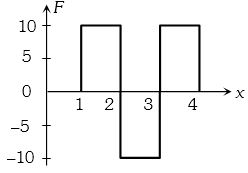
Figure shows the $F-x$ graph. Where $F$ is the force applied and $x$ is the distance coveredby the body along a straight line path. Given that $F$ is in newton and $x$ in metre, ........ $J$ is the work done.
The temperature to which a gas must be cooled before it can't be liquefied by pressure alone is called its: