MCQ
A particular emission line, detected in the light from a galaxy, has a wavelength $\lambda ' = 1.1\lambda $, where $\lambda $ is the proper wavelength of the line. The galaxy distance from us
  • $1.6 \times {10^9}ly$
  • B
    $0.97 \times {10^9}ly$
  • C
    $2.4 \times {10^9}ly$
  • D
    $1.62 \times {10^{11}}ly$

Answer

Correct option: A.
$1.6 \times {10^9}ly$
a
(a) From Hubble’s law $v = Hr$ where $H = $Hubble’s constant $= 19.3 mm/sec-ly$ and $ r = $

Distance of Galaxy from us.

According to Doppler’s effect speed of Galaxy $v = \frac{{c\Delta \lambda }}{\lambda }$

==> $r = \frac{{c\Delta \lambda }}{{H\lambda }} = \frac{{c \times 0.1\lambda }}{{H\lambda }} = \frac{{0.1\, \times 3 \times {{10}^8}}}{{19.3 \times 3 \times {{10}^{ - 3}}}} = 1.6 \times {10^9}\,ly$

Need a full question paper?

Generate a complete, print-ready paper with questions like this in minutes — across 16+ boards, with answer keys.

Start Generating Free

Similar questions

Let kinetic energy of a satellite is $x$, then its time of revolution $T$ is proportional to ..............
The binding energies per nucleon for a deuteron and an $\alpha - $ particle are $x_1$ and $x_2$ respectively. What will be the energy $Q$ released in the reaction $_1{H^2}{ + _1}{H^2}{ \to _2}H{e^4} + Q$
Two point dipoles of dipole moment ${\vec P_1}$ and ${\vec P_2}$ are at a distance $x$ from each other and  ${\vec P_1}$ || ${\vec P_2}$. The force between the dipoles is
The $e.m.f$. induced in a coil of wire, which is rotating in a magnetic field, does not depend on
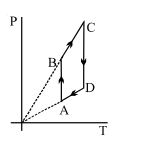
Pressure versus temperature graph of an ideal gas is shown in figure
A cubical volume is bounded by the surfaces $x =0, x = a , y =0, y = a , z =0, z = a$. The electric field in the region is given by $\overrightarrow{ E }= E _0 \times \hat{ i }$. Where $E _0=4 \times 10^4 NC ^{-1} m ^{-1}$. If $a =2 cm$, the charge contained in the cubical volume is $Q \times 10^{-14} C$. The value of $Q$ is $...........$

Take $\left.\varepsilon_0=9 \times 10^{-12} C ^2 / Nm ^2\right)$ 

A balloon of mass $m$ is descending down with an acceleration $\frac{g}{2}$.  How much mass should be removed from it so that it starts moving up with same acceleration?
A real gas behaves like an ideal gas if its
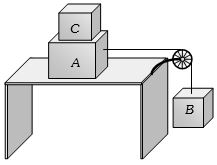
Two masses $A$ and $B$ of $10\, kg$ and $5 \,kg$ respectively are connected with a string passing over a frictionless pulley fixed at the corner of a table as shown. The coefficient of static friction of $A$ with table is $0.2$. The minimum mass of $C$ that may be placed on $A$ to prevent it from moving is ........ $kg$
A piece of ice slides down a rough inclined plane at $\theta=45^{\circ}$ inclination in twice the time that it takes to slide down an identical but frictionless inclined plane. What is the coefficient of friction between ice and incline ?