MCQ
A pendulum bob is swinging in a vertical plane such that its angular amplitude is less than $90^o$. At its highest point, the string is cut. Which trajectory is possible for the bob afterwards.
  • A

  • B


  • D

Answer

Correct option: C.

c

Need a full question paper?

Generate a complete, print-ready paper with questions like this in minutes — across 16+ boards, with answer keys.
Start Generating Free

Similar questions

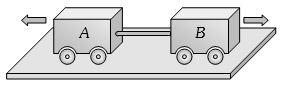
Two carts of masses $200\, kg$ and $300 \,kg$ on horizontal rails are pushed apart. Suppose the coefficient of friction between the carts and the rails are same. If the $200 \,kg$ cart travels a distance of $36 \,m$ and stops, then the distance travelled by the cart weighing $300 \,kg$ is ........ $m$
A particle is thrown with any velocity vertically upward, the distance travelled by the particle in first second of its decent is
Two bodies of mass $4 \mathrm{~g}$ and $25 \mathrm{~g}$ are moving with equal kinetic energies. The ratio of magnitude of their linear momentum is :
The time period of a particle in simple harmonic motion is equal to the smallest time between the particle acquiring a particular velocity $\overrightarrow{\text{v}}.$ The value of $v$ is
The potential energy $(U)$ of a diatomic molecule is a function dependent on $r$ (interatomic distance) as

$U =\frac{\alpha}{ r ^{10}}-\frac{\beta}{ r ^{5}}-3$

where, $\alpha$ and $\beta$ are positive constants. The equilibrium distance between two atoms will be $\left(\frac{2 \alpha}{\beta}\right)^{\frac{a}{b}},$ where a $=$ ..........
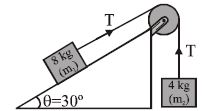
Two masses of $8\,kg$ and $4\,kg$ are connected by a string as shown in the figure over a fricitionless pulley. The acceleration of the system is  ............ $ m/sec^2$
A particle is forced to move on a straight line path. It returns to the starting point after $10$ seconds. The total distance covered by the particle during this time is $20m.$ Which of the following statements is false regarding the motion of the particles?
The kinetic energy of a particle executing $S.H.M.$ is $16\, J$ when it is at its mean position. If the mass of the particle is $0.32 \,kg$, then what is the maximum velocity of the particle ..... $m/s$
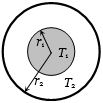
The figure shows a system of two concentric spheres of radii $r_1$ and $r_2$ and kept at temperatures $T_1$ and $T_2$, respectively. The radial rate of flow of heat in a substance between the two concentric spheres is proportional to
Kinetic theory of gases was put forward by