Question
A pendulum clock keeping correct time is taken to high altitudes:
  1. It will keep correct time.
  2. Its length should be increased to keep correct time.
  3. Its length should be decreased to keep correct time.
  4. It cannot keep correct time even if the length is changed.
Answer

  1. Its length should be decreased to keep correct time.

Explanation:

Time period of pendulum,

$\text{T}=2\pi\sqrt{\frac{\text{l}}{\text{g}}}$

At higher altitudes, the value of acceleration due to gravity decreases.

Therefore, the length of the pendulum should be decreased to compensate for the decrease in the value of acceleration due to gravity.

Need a full question paper?

Generate a complete, print-ready paper with questions like this in minutes — across 16+ boards, with answer keys.

Start Generating Free

Similar questions

Value of one light year distance:
The number of particles crossing per unit area perpendicular to X-axis in unit time is:
$\text{N}=-\text{D}\frac{\text{n}_2-\text{n}_1}{\text{x}_2-\text{x}_1}$
Where n1 and n2 are number of particles per unit volume for the value of x1 and x2 respectively. The dimensions of diffusion constant D are:
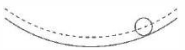
A ball is rolling without slipping in a spherical shallow bowl (radius $R$ ) as shown in the figure and is executing simple harmonic motion. If the radius of the ball is doubled, then the time period of oscillation
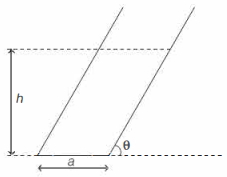
A hollow tilted cylindrical vessel of negligible mass rests on a horizontal plane as shown. The diameter of the base is $a$ and the side of the cylinder makes an angle $\theta$ with the horizontal.Water is then slowly poured into the cylinder. The cylinder topples over when the water reaches a certain height $h$, given by
A body of mass $M$ at rest explodes into three pieces, two of which of mass $M/4$ each are thrown off in perpendicular directions with velocities of $3\, m/s$ and $4\, m/s$ respectively. The third piece will be thrown off with a velocity of .......... $m/s$
The escape velocity for the earth is ${v_e}$. The escape velocity for a planet whose radius is four times and density is nine times that of the earth, is
$Assertion$ : A rocket moves forward by pushing the surrounding air backwards.

$Reason$ : It derives the necessary thrust to move forward according to Newton’s third law of motion

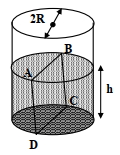
Water is filled up to a height $h$ in a beaker of radius $R$ as shown in the figure. The density of water is $\rho$, the surface tension of water is $T$ and the atmospheric pressure is $P_0$. Consider a vertical section $A B C D$ of the water column through a diameter of the beaker. The force on water on one side of this section by water on the other side of this section has magnitude
The moon revolves around the earth because the earth exerts a radial force on the moon. Does  the earth perform work on the moon?
An equilateral prism of mass $m$ rests on a rough horizontal surface with coefficient of friction $\mu$. A horizontal force $F$ is applied on the prism as shown in the figure.If the coefficient of friction is sufficiently high so that the prism does not slide before toppling, then the minimum force required to topple the prism is $-$