Question
A permutation is an act of arranging the objects or numbers in order. Combinations are the way of selecting the objects or numbers from a group of objects or collections, in such a way that the order of the objects does not matter.
Image
How many words, with or without meaning can be made from the letters of the word, $\text{MONDAY,}$ assuming that no letter is repeated if 
$(i) 4$ letters are used at a time
$(ii)$ all letters are used at a time

Answer

Total number of letters in word $\text{MONDAY} = 6$
Number of vowels in word $\text{MONDAY} = 2$
$(i)$ Number of letters used $= 4$
$\therefore$ Number of permutations $={ }^6 P_4=\frac{6!}{(6-4)!}$
$=\frac{6!}{2!}=\frac{6 \times 5 \times 4 \times 3 \times 2!}{2!}=360$
$(ii)$ Number of letters used $= 6$
$\therefore$ Number of permutations $={ }^6 P_6$
$=\frac{6!}{0!}$
$=6 \times 5 \times 4 \times 3 \times 2 \times 1$
$=720$

Need a full question paper?

Generate a complete, print-ready paper with questions like this in minutes — across 16+ boards, with answer keys.

Start Generating Free

Similar questions

Consider the data.
Class Frequency
$0-10$ $6$
$10-20$ $7$
$20-30$ $ 15$
$30-40$ $ 16$
$40-50$ $4$
$50-60$ $2$
$i$. Find the mean deviation about median. $(1)$
$ii$. Find the Median. $(1)$
$iii$. Write the formula to calculate the Mean deviation about median? $(2)$
OR
Write the formula to calculate median? $(2)$
An analysis of monthly wages paid to workers in two firms $A$ and $B,$ belonging to the same industry, gives the following results:
Particulars Firm $A$ Firm $B$
No. of wage earners $586$ $648$
Mean of monthly wages $₹ 5253$ $₹ 5253$
Variance of the distribution of wages $100$ $121$

Image

$i$. Which firm $A$ or $B$ shows greater variability in individual wages? $(1)$
$ii$. Find the standard deviation of the distribution of wages for frim $B.\ (1)$
$iii$. Find the coefficient of variation of the distribution of wages for firm $A. \ (2)$
OR
Find the amount paid by firm $A. \ (2$)
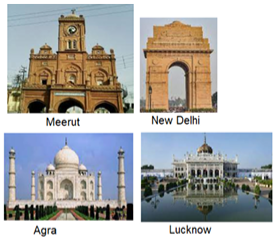
On her vacation, Priyanka visits four cities. Delhi, Lucknow, Agra, Meerut in a random order.
Image

$i$. What is the probability that she visits Delhi before Lucknow? $(1)$
$ii$. What is the probability she visit Delhi before Lucknow and Lucknow before Agra? $(1)$
$iii.$ What is the probability she visits Delhi first and Lucknow last? $(2)$
OR
What is the probability she visits Delhi either first or second? $(2)$
To find the limits of trigonometric functions, we use the following theorems
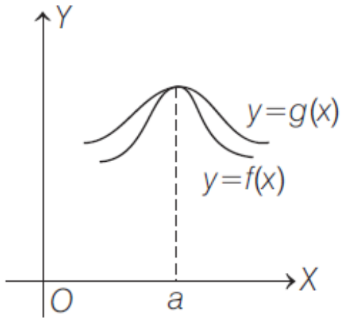
Theorem 1: Let $f$ and $g$ be two real valued functions with the same domain such that $f(x) \leq g(x)$ for all $x$ in the domain of definition. For some real number $a$, if both $\lim _{x \rightarrow a} f(x)$ and $\lim _{x \rightarrow a} g(x)$ exist, then
$
\lim _{x \rightarrow a} f(x) \leq \lim _{x \rightarrow a} g(x) .
$
This is shown in the figure
Image

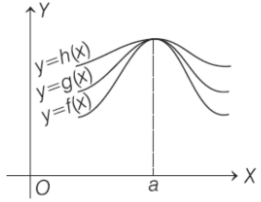
Theorem 2 (Sandwich theorem) : Let $f, g$ and $h$ be real functions such that $f(x) \leq g(x) \leq h(x)$ for all $x$ in the common domain of definition. For some real number $a$, if $\lim _{x \rightarrow a} f(x)=l=\lim _{x \rightarrow a} h(x)$, then $\lim _{x \rightarrow a} g(x)=l$.

This is shown in the figure
Image

Theorem 3 : Three important limits are
(i) $\lim _{x \rightarrow 0} \frac{\sin x}{x}=1$
(ii) $\lim _{x \rightarrow 0} \frac{\frac{x}{1-\cos x}}{x}=0$
(iii) $\lim _{x \rightarrow 0} \frac{\tan ^x x}{x}=1$

Based on above information, answer the following questions.

(i) $\lim _{x \rightarrow 0} \frac{\sin 3 x}{5 x}$ is equal to
    (a) $\frac{1}{5}$     (b) $\frac{2}{5}$     (c) $\frac{3}{5}$     (d) $\frac{4}{5}$

(ii) $\lim _{\theta \rightarrow b} \frac{\tan (\theta-b)}{\theta-b}$ is equal to
    (a) 0     (b) 1     (c) 2     (d) 3

(iii) $\lim _{x \rightarrow 0} \frac{\tan 2 x-\sin 2 x}{x^3}$ is equal to
    (a) 4     (b) 3     (c) 2     (d) 1

(iv) $\lim _{x \rightarrow 0} \frac{2 \sin x-\sin 2 x}{x^3}$ is equal to
    (a) 0     (b) 1     (c) 2     (d) 3

(v) $\lim _{x \rightarrow \frac{\pi}{4}} \frac{\sin x-\cos x}{x-\frac{\pi}{4}}$ is equal to
    (a) $\sqrt{2}$     (b) 3     (c) 1     (d) $\sqrt{3}$
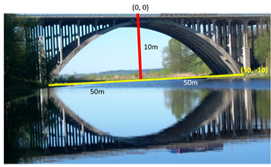
The girder of a railway bridge is a parabola with its vertex at the highest point, $10\ m$ above the ends. Its span is $100 \ m$. 
Image
$i$. Find the coordinates of the focus of the parabola. $(1)$
$ii$. Find the equation of girder of bridge and find the length of latus rectum of girder of bridge.$ (1)$
$iii$. Find the height of the bridge at $20\ m$ from the mid $-$ point. $(2)$
OR
Find the radius of circle with centre at focus of the parabola and passes through the vertex of parabola. $(2)$
 
In a class test of class XI, a teacher asked to students to consider $\mathbf{A}+\mathbf{B}=\frac{\pi}{4}$, where $\mathbf{A}$ and $\mathbf{B}$ are acute angles.
Based on the above information, answer the following questions.
(i) Find the value of $(1+\tan A)(1+\tan B)$ ?
(ii) Find the value of $(\cot \mathbf{A}-1)(\cot \mathbf{B}-1)$ ?
(iii) Find the value of
$
\sin (A+B)-\cos (A+B)+\tan (A+B) .
$
In a library, $25$ students read physics, chemistry and mathematics books. It was found that $15$ students read mathematics, $12$ students read physics while $11$ students read chemistry. $5$ students read both mathematics and chemistry, $9$ students read physics and mathematics. $4$ students read physics and chemistry and $3$ students read all three subject books.

Based on the above information, answer the following questions.
  1. The number of students who reading only chemistry is:
  1. $5$
  2. $4$
  3. $2$
  4. $1$
  1. The number of students who reading only mathematics is:
  1. $4$
  2. $3$
  3. $5$
  4. $11$
  1. The number of students who reading only one of the subjects is:
  1. $5$
  2. $11$
  3. $8$
  4. $6$
  1. The number of students who reading atleast one of the subject is:
  1. $20$
  2. $22$
  3. $23$
  4. $21$
  1. The number of students who reading none of the subject is:
  1. $2$
  2. $4$
  3. $3$
  4. $5$
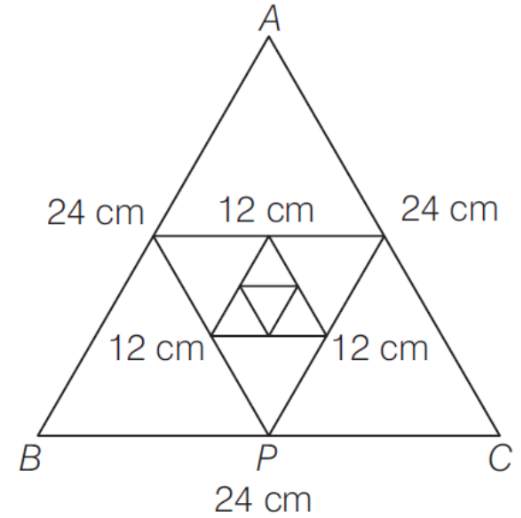
Each side of an equilateral triangle is $24 \mathrm{~cm}$. The mid-point of its sides are joined to form another triangle. This process is going continuously infinite.
Image
Based on above information, answer the following questions.

(i) The side of the 5th triangle is (in $\mathrm{cm}$)
    (a) 3     (b) 6     (c) 1.5     (d) 0.75

(ii) The sum of perimeter of first 6 triangle is (in $\mathrm{cm}$)
    (a) $\frac{569}{4}$     (b) $\frac{567}{4}$     (c) 120     (d) 144

(iii) The area of all the triangle is (in sq $\mathrm{cm}$ )
    (a) 576     (b) $192 \sqrt{3}$     (c) $144 \sqrt{3}$     (d) $169 \sqrt{3}$

(iv) The sum of perimeter of all triangle is (in $\mathrm{cm}$ )
    (a) 144     (b) 169     (c) 400     (d) 625

(v) The perimeter of 7 th triangle is (in $\mathrm{cm}$ )
    (a) $\frac{7}{8}$     (b) $\frac{9}{8}$     (c) $\frac{5}{8}$     (d) $\frac{3}{4}$
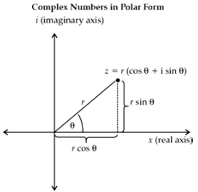
Consider the complex number $Z = 2 - 2i.$ Complex Number in Polar Form
Image
$i.$ Find the principal argument of $Z . (1)$
$ii.$ Find the value of $\bar{z} \bar{z}$ ? $(1)$
$iii.$ Find the value of $| Z |. (2)$
OR
Find the real part of $Z. (2)$