Question
A person suffering from myopia cannot see clearly :

Answer

(B) - distant objects

Need a full question paper?

Generate a complete, print-ready paper with questions like this in minutes — across 16+ boards, with answer keys.
Start Generating Free

Similar questions

The minimum orbital angular momentum of the electron in a hydrogen atom is:
  1. $\text{h}$
  2. $\frac{\text{h}}{2}$
  3. $\frac{\text{h}}{2\pi}$
  4. $\frac{\text{h}}{\lambda}$
Two parallel slits 0.6 mm apart are illuminated by light source of wavelength 6000 Å. The distance between two consecutive dark fringes on a screen 1 m away from the slits is (a) 1 mm(b) 0.01 mm (c) 0.1 m(d) 10 m
       
Work function of a metal is $2.51\ eV.$ Its threshold frequency is
A condenser of capacity $50\ \mu F$ is charged to $10$ volts. Its energy is equal to
For a substance the average life for a-emission is 1620 years and for b emission is 405 years. After how much time the 1/4 of the material remains after a and b emission(a) 1500 years(b) 300 years(c) 449 years(d) 810 years
       
In Young’s experiment, the distance between slits is 0.28 mm and distance between slits and screen is 1.4 m. Distance between central bright fringe and third bright fringe is 0.9 cm. What is the wavelength of used light (a) 5000 Å(b) 6000 Å(c) 7000 Å(d) 9000 Å
       
If the magnification of optical instrument is negative, then the image will always be formed :
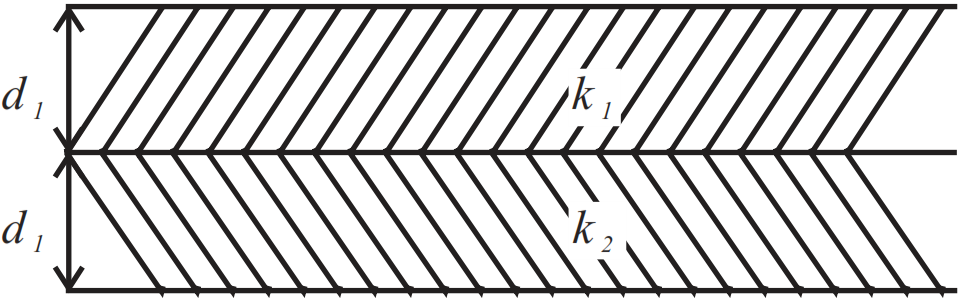
A parallel plate capacitor is made of two dielectric blocks in series. One of the blocks has thickness $d_1$ and dielectric constant $k_1$ and the other has thickness $d_2$ and dielectric constant $k_2$ as shown in Fig.

This arrangement can be thought as a dielectric slab of thickness $d (= d_1 + d_2)$ and effective dielectric constant $k$. The $k$ is
The electric field lines are crowded where electric field is:
Wave which cannot travel in vacuum is(a) X-rays  (b) Infrasonic(c) Ultraviolet(d) Radiowaves