MCQ
A photon in motion has a mass
  • A
    $c/h\nu $
  • B
    $h/\nu $
  • C
    $h\nu $
  • $h\nu /{c^2}$

Answer

Correct option: D.
$h\nu /{c^2}$
d
(d)$E = h\nu = m{c^2}\, \Rightarrow \,\,m = \frac{{h\nu }}{{{c^2}}}$

Need a full question paper?

Generate a complete, print-ready paper with questions like this in minutes — across 16+ boards, with answer keys.

Start Generating Free

Similar questions

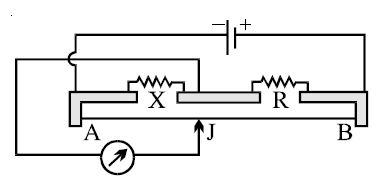
The figure shows a meter-bridge circuit, with $AB = 100\, cm$,$ X = 12\,\Omega$ and $R = 18\,\Omega$ , and the jockey $J$ in the position of balance. If $R$ is now made $8\,\Omega$ , through what distance will $J$ have to be moved to obtain balance? .............. $cm$
If the energy of the photon is increased by a factor of $4$, then its momentum
Plutonium decays with a half-life of $24000 \,years$. If the plutonium is stored for $72000 \,years$, then the fraction of plutonium that remains is
The inductive reactance of an inductor of $\frac{1}{\pi }$ henry at $50\, Hz$ frequency is.....$ohm$
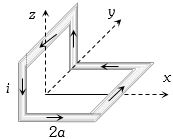
A non-planar loop of conducting wire carrying a current $I$ is placed as shown in the figure. Each of the straight sections of the loop is of length $2a$. The magnetic field due to this loop at the point $P$ $(a,0,a)$ points in the direction
Tritium is an isotope of hydrogen whose nucleus Triton contains $2$ neutrons and $1$ proton. Free neutrons decay into $\text{p}+\overline{\text{e}}+\overline{\text{v}}$. If one of the neutrons in Triton decays, it would transform into $He^3$ nucleus. This does not happen. This is because:
Dimensions of a block are $1\,cm \times 1\,cm \times 100\,cm$. If specific resistance of its material is $3 \times {10^{ - 7}}\,ohm - m$, the resistance between the square faces is
If resistance of the filament increases with temperature, what will be power dissipated in a $220\, V- 100\, W$ lamp when connected to $110\, V$ power supply
The relation between $\lambda $ and $({T_{1/2}})$ is (${T_{1/2}}=$ half life, $\lambda=$ decay constant)
The $\beta$-decay process, discovered around $1900$ , is basically the decay of a neutron ( $n$ ), In the laboratory, a proton ( $p$ ) and an electron ( $e ^{-}$) are observed as the decay products of the neutron. therefore, considering the decay of a neutron as a tro-body dcay process, it was predicted theoretically that thekinetic energy of the electron should be a constant. But experimentally, it was observed that the electron kinetic energy has a continuous spectrum. Considering a three-body decay process, i.e. $n \rightarrow p+ e ^{-}+\bar{v}_{ e }$, around $1930,$ Pauli explained the observed electron energy spectrum. Assuming the anti-neutrino $\left(\bar{v}_{ e }\right)$ to be massless and possessing negligible energy, and neutron to be at rest, momentum and energy conservation principles are applied. From this calculation, the maximum kinetic energy of the lectron is $0.8 \times 10^6 eV$. The kinetic energy carried by the proton is only the recoil energy.

$1.$ What is the maximum energy of the anti-neutrino?

$(A)$ Zero

$(B)$ Much less than $0.8 \times 10^6 \ eV$

$(C)$ Nearly $0.8 \times 10^6 \ eV$

$(D)$ Much larger than $0.8 \times 10^6 \ eV$

$2.$ If the anti-neutrino had a mass of $3 eV / c ^2$ (where $c$ is the speed of light) instead of zero mass, what should be the range of the kinetic energy, $K$, of the electron?

$(A)$ $0 \leq K \leq 0.8 \times 10^6 \ eV$

$(B)$ $3.0 eV \leq K \leq 0.8 \times 10^6 \ eV$

$(C)$ $3.0 eV \leq K < 0.8 \times 10^6 \ eV$

$(D)$ $0 \leq K < 0.8 \times 10^6 \ eV$

Give the answer question $1$ and $2.$