MCQ
A photon will have less energy, if its:
  • A
    Amplitude is higher
  • B
    Frequency is higher
  • C
    Wavelength is longer
  • D
    Wavelength is shorter

Answer

  1. Wavelength is longer

Explanation:

Energy of photon $=\frac{\text{hc}}{\gamma}$

Hence, a photon with longer wavelenght will carry less energy.

Need a full question paper?

Generate a complete, print-ready paper with questions like this in minutes — across 16+ boards, with answer keys.

Start Generating Free

Similar questions

The radius of a nucleus is:
Mx and My denote the atomic masses of the parent and the daughter nuclei respectively in a radioactive decay. The Q-value for a β- decay is Q1 and that for a β+ decay is Q2. If me denotes the mass of an electron, then which of the following statements is correct?
In series combination of resistances:
A very thin film in reflected white light appears:

In the above figure D and E respectively represent

(a) Absorption line of Balmer series and the ionization potential of hydrogen

(b) Absorption line of Balmer series and the wavelength lesser than lowest of the Lyman series

(c) Spectral line of Balmer series and the maximum wavelength of Lyman series

(d) Spectral line of Lyman series and the absorption of greater wavelength of limiting value of Paschen series

In ballistic galvanometer, the frame on which the coil is wound is non - metallic to:
A coil of circular cross-section having 1000 turns and 4cm2 face area is placed with its axis parallel to a magnetic field which decreases by 10–2 Wb m–2 in 0.01 s. The e.m.f. induced in the coil is:
If two soap bubbles of different radii are connected by a tube:
  1. Air flows from bigger bubble to the smaller bubble till the sizes become equal.
  2. Air flows from bigger bubble to the smaller bubble till the sizes are interchanged.
  3. Air flows from the smaller bubble to the bigger.
  4. There lis no flow of air.

A conducting square loop of side l and resistance R moves in its plane with a uniform velocity v perpendicular to one of its sides. A magnetic induction B constant in time and space, pointing perpendicular and into the plane at the loop exists everywhere with half the loop outside the field, as shown in figure. The induced e.m.f. is
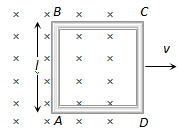
(a) Zero  

(b) RvB

(c) VBl/R

(d) VBl

Which of the following particles will describe the smallest circle when projected with the same velocity perpendicular to a magnetic field?