Question
A plane electromagnetic wave is passing through a region. Consider (a) electric field (b) magnetic field (c) electrical energy in a small volume and (d) magnetic energy in a small volume. Construct the pairs of the quantities that oscillate with equal frequencies.
Answer

Let the electromagnetic wave be propagating in the z-direction. The vibrations of the electric and magnetic fields are given by,$\text{E}_\text{x}=\text{E}_0\sin(\text{kz}-\omega\text{t})$
$\text{B}_\text{y}=\text{B}_0\sin(\text{kz}-\omega\text{t})$
Let the volume of the region be V. The angular frequency of the vibrations of the electric and magnetic fields are same and are equal to $\omega$ Therefore, their frequency, $\text{f}=\frac{\omega}{2\pi},$ is same. The electrical energy in the region,$\text{U}_\text{E}=\Big(\frac{1}{2}\in_0\text{E}^2\Big)\times\text{V}$
It can be written as,$\text{U}_\text{E}=\Big(\frac{1}{2}\in_0\big(\text{E}^2_0\sin^2(\text{kz}-\omega\text{t})\big)\Big)\times\text{V}$
$\text{U}_\text{E}=\Bigg(\frac{1}{2}\in_0\text{E}_0^2\times\frac{\big(1-\cos2(\text{kz}-\omega\text{t})\big)}{2}\Bigg)\times\text{V}$
$\text{U}_\text{E}=\Big(\frac{1}{4}\in_0\text{E}_0^2\times(1-\cos2(\text{kz}-\omega\text{t}))\Big)\times\text{V}$
The magnetic energy in the region,$\text{U}_\text{B}=\Big(\frac{\text{B}^2}{2\mu_0}\Big)\times\text{V}$
$\text{U}_\text{B}=\bigg(\frac{\text{B}^2_0\sin^2(\text{kz}-\omega\text{t})}{2\mu_0}\bigg)\times\text{V}$
$\text{U}_\text{B}=\Bigg(\frac{\text{B}^2_0\big(1-\cos(2\text{kz}-2\omega\text{t})\big)}{4\mu_0}\Bigg)\times\text{V}$
The angular frequency of the electric and magnetic is same and is equal to $2\omega$ Therefore, their frequency,$\text{f}'=\frac{2\omega}{2\pi}=2\text{f}$
Will be same. Thus, the electric and magnetic fields have same frequencies and the electrical and magnetic energies will have same frequencies.

Need a full question paper?

Generate a complete, print-ready paper with questions like this in minutes — across 16+ boards, with answer keys.

Start Generating Free

Similar questions

Figure. shows an arrangement to measure the emf $\in$ and internal resistance r of a battery. The voltmeter has a very high resistance and the ammeter also has some resistance. The voltmeter reads 1.52V when the switch S is open. When the switch is closed, the voltmeter reading drops to 1.45V and the ammeter reads 1.0A. Find the emf and the internal resistance of the battery.
  1. Draw the circuit diagrams of a p-n junction diode in (i) forward bias, (ii) reverse bias. How are these circuits used to study the V - I characteristics of a silicon diode? Draw the typical V - I characteristics.
  2. What is a light emitting diode (LED)? Mention two important advantages of LEDs over conventional lamps.
Let $\text{X}=\overline{\text{ABC}}+\overline{\text{BCA}}+\overline{\text{CAB}}.$ Evaluate X for:
  1. $\text{A}=1,\text{B}=0,\text{C}=1$
  2. $\text{A}=\text{B}=\text{C}=1$
  3. $\text{A}=\text{B}=\text{C}=0$
What is meant by forward bias and reverse bias of p-n junction diode? Draw experimental electrical circuit diagram to study V-I characteristic in forward bias and reverse bias of p-n junction diode. Draw forward bias and reverse bias V-I characteristic curves of p-n junction diode and briefly explain the following :
(i) Threshold or cut-in voltage
(ii) Breakdown voltage.
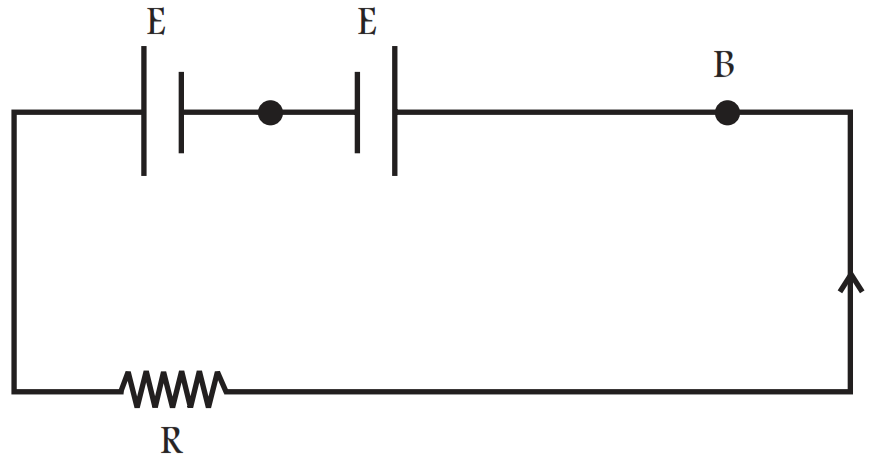
Two cells of same emf E but internal resistance $r_1$ and $r_2$ are connected in series to an external resistor R (Fig). What should be the value of R so that the potential difference across the terminals of the first cell becomes zero.
For a circular coil of radius R and N turns carrying current I, the magnitude of the magnetic field at a point on its axis at a distance x from its centre is given by,
$\text{B}=\frac{\mu_{0}\text{IR}^{2}\text{N}}{2(\text{x}^{2}+\text{R}^{2})^{\frac{3}{2}}}$
  1. Show that this reduces to the familiar result for field at the centre of the coil.
  2. Consider two parallel co-axial circular coils of equal radius R, and number of turns N, carrying equal currents in the same direction, and separated by a distance R. Show that the field on the axis around the mid-point between the coils is uniform over a distance that is small as compared to R, and is given by,$\text{B}=0.72\frac{\mu_{0}\text{NI}}{\text{R}}$, approximately.
[Such an arrangement to produce a nearly uniform magnetic field over a small region is known as Helmholtz coils.]
Draw the symbolic representation of a (i) p-n-p, (ii) n-p-n transistor. Why is the base region of transistor thin and lightly doped? With proper circuit diagram, show the biasing of a p-n-p transistor in common base configuration. Explain the movement of charge carriers through different parts of the transistor in such a configuration and show that $\text{I}_{E}= \text{I}_{C} =\text{I}_{B}$.
(i) Obtain an expression for torque acting on a rectangular current carrying coil in a uniform magnetic field. (ii) Calculate magnetic dipole of a circular electric current loop.
equiconvex lens (of refractive index 1.50) in contact with a liquid layer on top of a plane mirror. A small needle with its tip on the principal axis is moved along the axis until its inverted image is found at the position of the needle. The distance of the needle from the lens is measured to be 45.0 cm. The liquid is removed and the experiment is repeated. The new distance is measured to be 30.0 cm. What is the refractive index of the liquid?
State and Prove Gauss theorem in electrostatics.