Question
A plane electromagnetic wave is propagating along Y -axis in vacuum. Write about the (i) ratio of magnitudes and (ii) directions of electric and magnetic fields.

Answer

(i) $E / B =c$, where $E =|\overrightarrow{ E }| ; B =|\overrightarrow{ B }|$ and $c=$ speed of light.
(ii) Electric and magnetic field vector $\vec{E}$ and $\vec{B}$ will be respectively along the Z -axis and X -axis. They will be perpendicular to the direction of transmission of wave.

Need a full question paper?

Generate a complete, print-ready paper with questions like this in minutes — across 16+ boards, with answer keys.
Start Generating Free

Similar questions

Does the polarising angle for any transparent medium depend on the wavelength of light?
Identify the electromagnetic waves whose wavelengths vary as
  1. $10^{-12 \mathrm{~m}}<\lambda<10^{-8} \mathrm{~m}$
  2. $10^{-3 \mathrm{~m}}<\lambda<10^{-1} \mathrm{~m}$
Write one use for each.
A car weighing 1400kg is moving at a speed of 54km/h up a hill when the motor stops. If it is just able to reach the destination which is at a height of 10m above the point, calculate the work done against friction (negative of the work done by the friction).
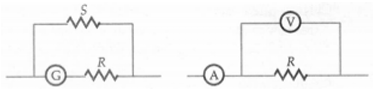
A galvanometer has a resistance of $8 \Omega$ . It gives a full scale deflection for a current of $10 \ mA.$ It is to be converted into an ammeter of range $5 A.$ The only shunt resistance available is of $0.02 \Omega$ , which is not suitable for this conversion. Find the value of resistance $R$ that must be connected in series with the galvanometer $($Fig$.)$ to get ammeter of desired range.
Image
Show that the slope of p-V diagram is greater for an adiabatic process as compared to an isothermal process.
A radioactive nucleus ‘A’ undergoes a series of decays according to the following scheme:$\text{A} - \xrightarrow{a}\text{A}_{1} \xrightarrow{\beta}\text{A}_{2}\xrightarrow{\alpha}\text{A}_{3}\xrightarrow{\gamma}\text{A}_{4}$
The mass number and atomic number of A are 180 and 72 respectively. What are these numbers for $A_4?$
A convex lens of refractive index 1.5 has a focal length of 18cm in air. Calculate the change in its focal length when it is immersed in water of refractive index $\frac{4}{3}$
Draw the graph between the frequency of the incident light and the stopping potential in the experiment of photoelectric.
The angles of dip at two places located on the earth are 0° and 90° respectively. Where are the places located?
  1. How are infrared waves produced? Write their one important use.
  2. The thin Ozone layer on top of the stratosphere is crucial for human survival. Why?