Question
A plane passes through the point (1, -2, 5) and is perpendicular to the line joining the origin to the point $2\hat{\text{i}}+\hat{\text{j}}-\hat{\text{k}}.$ Find the vector and cartesian forms of the equation of the plane.

Answer

The normal is passing throught the point A(0, 0, 0) and B(3, 1, -1). So,
$\vec{\text{n}}=\overrightarrow{\text{OP}}$
$=(3\hat{\text{i}}+\hat{\text{j}}-\hat{\text{k}})-(0\hat{\text{i}}+0\hat{\text{j}}+0\hat{\text{k}})$
$=3\hat{\text{i}}+\hat{\text{j}}-\hat{\text{k}}$
Since the plane passes throught (1, -2, 5)
$\vec{\text{a}}=\hat{\text{i}}-2\hat{\text{j}}+5\hat{\text{k}}$
We know that the vector equation of the plane passing through a point $\vec{\text{a}}$ and normal to $\vec{\text{n}}$ is,
$\vec{\text{r}}\cdot\vec{\text{n}}=\vec{\text{a}}\cdot\vec{\text{n}}$
Substituting $\vec{\text{a}}=\hat{\text{i}}-\hat{\text{j}}+\hat{\text{k}}$ and $\vec{\text{n}}=4\hat{\text{i}}+2\hat{\text{j}}-3\hat{\text{k}},$ we get
$\vec{\text{r}}\cdot(3\hat{\text{i}}+\hat{\text{j}}-\hat{\text{k}})=(\hat{\text{i}}-2\hat{\text{j}}+5\hat{\text{k}})\cdot(3\hat{\text{i}}+\hat{\text{j}}-\hat{\text{k}})$
$\Rightarrow\vec{\text{r}}\cdot(3\hat{\text{i}}+\hat{\text{j}}-\hat{\text{k}})=3-2-5$
$\Rightarrow\vec{\text{r}}\cdot(3\hat{\text{i}}+\hat{\text{j}}-\hat{\text{k}})=-4$
Substituting $\vec{\text{r}}=\text{x}\hat{\text{i}}+\text{y}\hat{\text{j}}+\text{z}\hat{\text{k}}$ in the vector equation we get
$(\text{x}\hat{\text{i}}+\text{y}\hat{\text{j}}+\text{z}\hat{\text{k}})\cdot(3\hat{\text{i}}+\hat{\text{j}}-\hat{\text{k}})=-4$
$\Rightarrow3\text{x}+\text{y}-\text{z}=-4$

Need a full question paper?

Generate a complete, print-ready paper with questions like this in minutes — across 16+ boards, with answer keys.
Start Generating Free

Similar questions

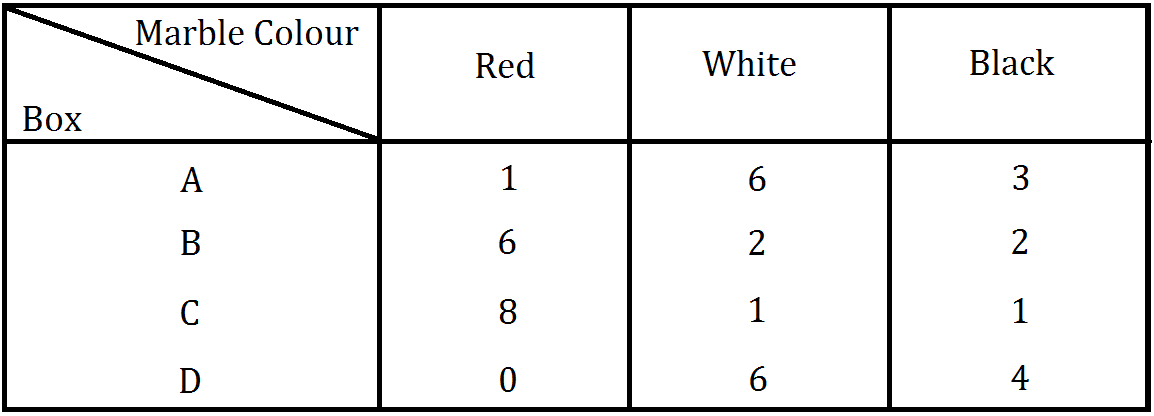
Suppose we have four boxes A, B, C, D containing coloured marbles as given below:
One of the boxes has been selected at random and a single marble is drawn from it. If the marble is red, what is the probability that it was drawn from,
  1. Box A?
  2. Box B?
  3. Box C?
Find the points o local maxima or local minima, if any, of the following functions, using the first derivatives test. Also, find the local maximum or local minimum values, as the case may be:$f(x) = (x - 1)(x + 2)^2$​​​​​​​
Solve the following LPP graphically:
Minimise Z = 3x + 9y
subject to the constraints
x + 3y $\leq$ 60
x + y $\geq$ 10
x $\leq$ y
x $\geq$ 0, y $\geq$ 0.
Evaluate the following intregals:
$\int\frac{\text{x}+1}{\sqrt{4+5\text{x}-\text{x}}}\text{ dx}$
If $\text{f(x)}=\sqrt{\text{x}^2+9},$ Write the value of $\lim\limits_{\text{x}\rightarrow4}\frac{\text{f(x)}-\text{f}(4)}{\text{x}-4}.$
Find a point on the curve $y = x^3 + 1$ where the tangent is parallel to the chord joining $(1, 2)$ and $(3, 28).$
Find the equations of the tangent and the normal to the following curves at the indicated points.
$\frac{\text{x}^2}{\text{a}^2}-\frac{\text{y}^2}{\text{b}^2}=1\text{ at }(\text{x}_0,\text{y}_0)$
Show that $\text{f}(\text{x})=\sin\text{x}$ is increasing on $\Big(0,\frac{\pi}{2}\Big)$ and decreasing on $\Big(\frac{\pi}{2},\pi\Big)$ and neither increasing nor decreasing in $(0,\pi).$
Evaluate the following integrals:
$\int\limits^{\text{a}}_{-\text{a}}\sqrt{\frac{\text{a}-\text{x}}{\text{a}+\text{x}}}\text{ dx}$
A card is drawn from a pack of 52 cards so that each card is equally likely to be selected. In which of the following cases are the events A and B independent?
A = the card drawn is a spade,
B = the card drawn in an ace.