Question
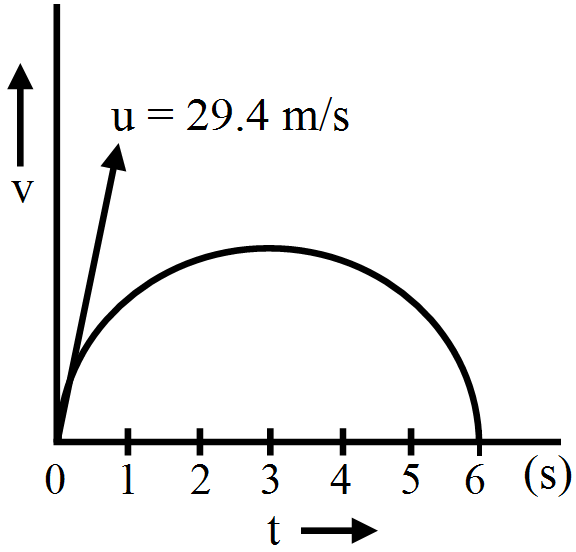
A point object is thrown vertically upwards at such a speed that it returns to the thrower after 6 seconds. With what speed was it thrown up and how high did it rise? Plot speed time graph for the object and use it to find the distance travelled by it in the last second of its journey.
Answer

$\text{v}=\text{u}+\text{at}$ with $\text{v}=-\text{u},\text{a}=-9.8\text{m/s}^2$ $\text{t}=6\text{s}$ $\therefore \text{u}=29.4\text{m/s}$ Time of ascent + Time of descent = 6s $\text{t}_1+\text{t}_2=6\text{s}$ and $\text{t}_1=\text{t}_2=\text{t}$ $\text{s}=\text{ut}+\frac{1}{2}\text{at}^2$ $\text{t}=3\text{s}$ $\text{s}=(29.4\text{m/s})(3\text{s})+\frac{1}{2}(-9.8\text{m/s}^2)(3)^2$ $=88.2\text{m}-44.1\text{m}$ $=44.1\text{m}$ Distance travelled by it in last second = area under the curve = 24.5m.
Need a full question paper?

Generate a complete, print-ready paper with questions like this in minutes — across 16+ boards, with answer keys.

Start Generating Free

Similar questions

Two current-carrying wires may attract each other. In absence of other forces, the wires will move towards each other increasing the kinetic energy. Does it contradict the fact that the magnetic force cannot do any work and hence cannot increase the kinetic energy?
A particle of mass $100g$ moving at an initial speed u collides with another particle of same mass kept initially at rest. If the total kinetic energy becomes $0.2J$ after the collision, what could be the minimum and the maximum value of u.
  1. Write the Hooke's law.
  2. A steel wire of length $4m$ and diameter $5mm$ is stretched by $5kg-wt$. Find the increase in its length, if the young's modulus of steel wire is $2.4 \times 10^{12}$ dyne $cm^{-2}$?
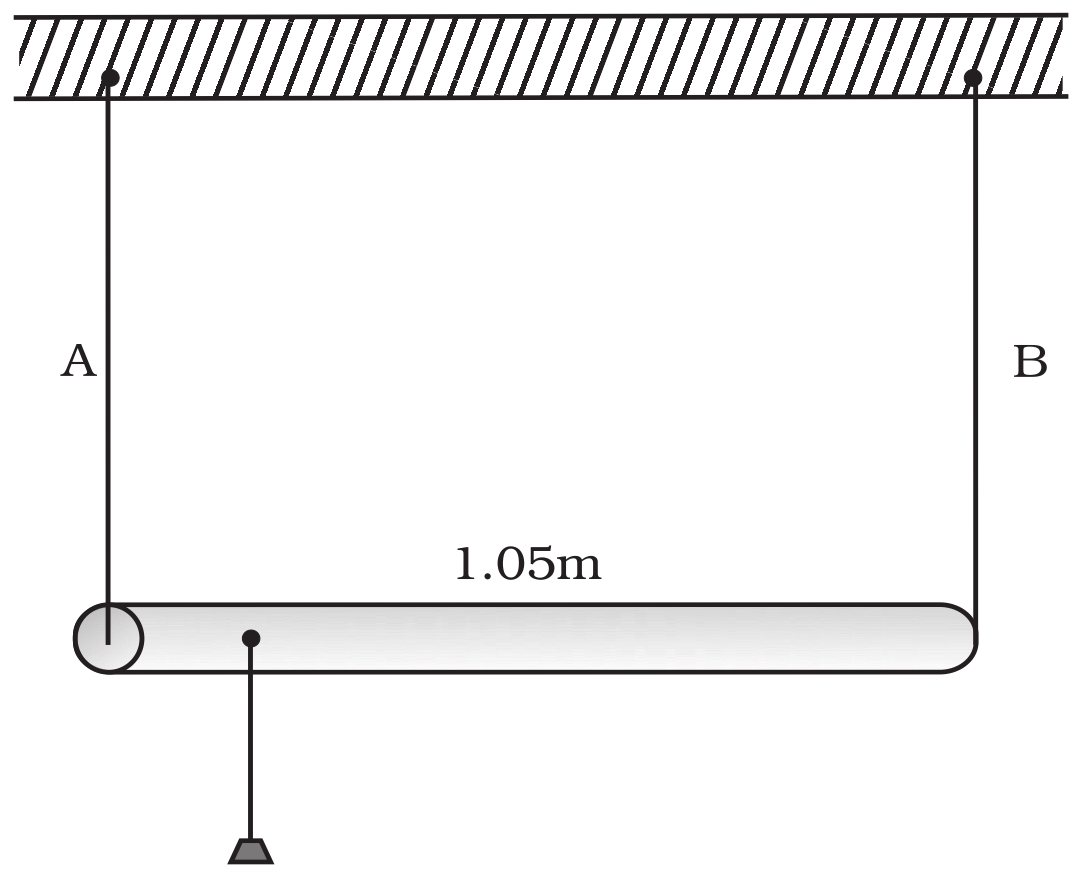
A rod of length $1.05m$ having negligible mass is supported at its ends by two wires of steel (wire A) and aluminium (wire B) of equal lengths as shown in Fig. The cross-sectional areas of wires A and B are $1.0mm^2$ and $2.0mm^2$, respectively. At what point along the rod should a mass m be suspended in order to produce (a) equal stresses and (b) equal strains in both steel and aluminium wires.
A metre stick is balanced on a knife edge at its centre. When two coins, each of mass 5g are put one on top of the other at the 12.0cm mark, the stick is found to be balanced at 45.0cm. What is the mass of the metre stick?
An artificial satellite of mass $100kg$ is in a circular orbit at $500km$ above the earth's surface.
  1. Find the acceleration due to gravity at any point along the satellite path.
  2. What is the centripetal acceleration of the satellite?
Take radius of earth as $6.5 \times 10^6m$.
A bullet of mass 25g is fired horizontally into a ballistic pendulum of mass 5.0kg and gets embedded in it. If the centre of the pendulum rises by a distance of 10cm, find the speed of the bullet.
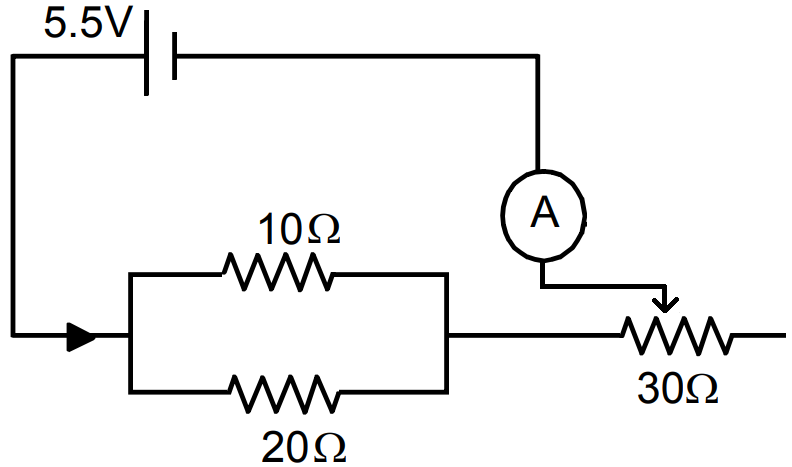
The resistance of the rheostat shown in the figure. is $30\Omega.$ Neglecting the meter resistance, find the minimum and maximum currents through the ammeter as the rheostat is varied.
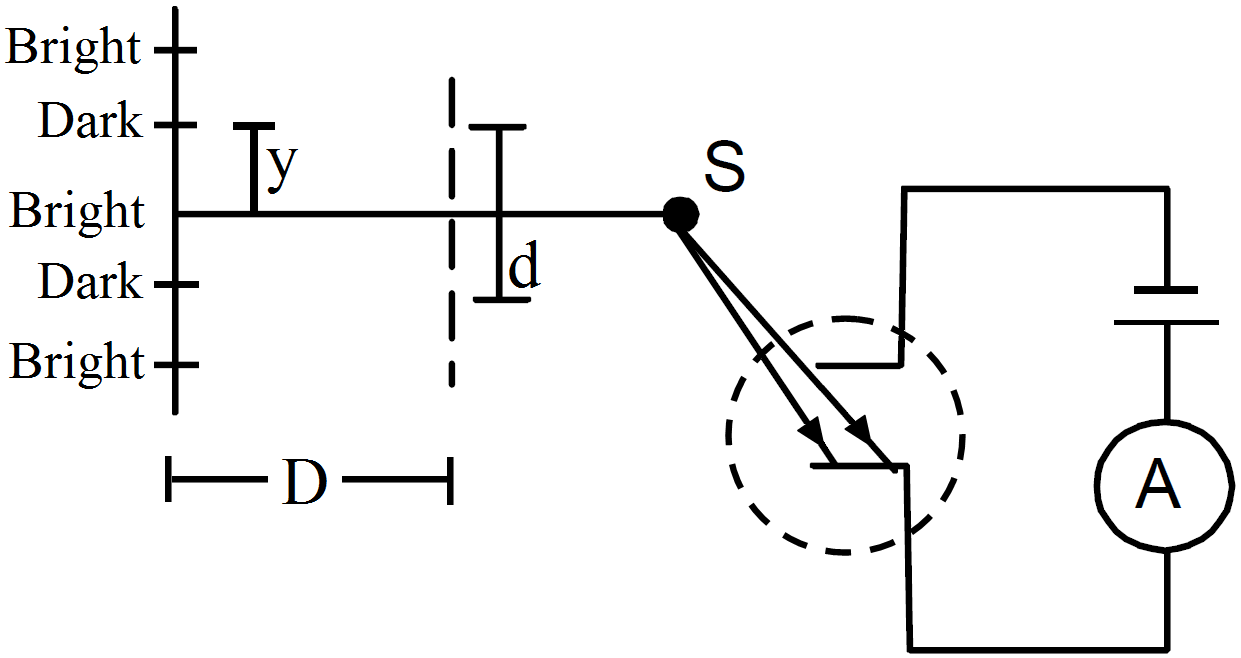
In the arrangement shown in figure $y = 1.0mm. d = 0.24mm$ end $D = 1.2m$. The work function of the materiel of the emitter is $2.2eV$. Find the stopping potential V needed to stop the photocurrent.
A vessel filled with water is kept on a weighing pan and the scale adjusted to zero. A block of mass $M$ and density $\rho$ is suspended by a massless spring of spring constant $k$. This block is submerged inside into the water in the vessel. What is the reading of the scale?