MCQ

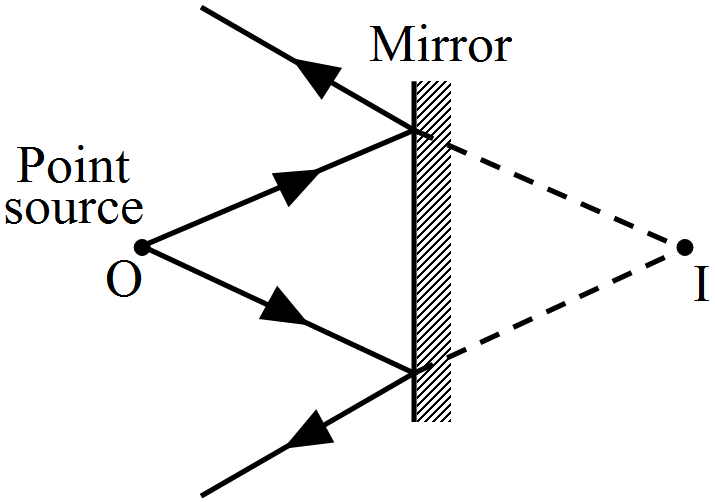
A point source of light is placed in front of a plane mirror:

  • A
    All the reflected rays meet at a point when produced backward.
  • B
    Only the reflected rays close to the normal meet at a point when produced backward.
  • C
    Only the reflected rays making a small angle with the mirror, meet at a point when produced backward.
  • D
    Light of different colours make different images.
Answer

  1. All the reflected rays meet at a point when produced backward.

Explanation:

​​​​​​​

Need a full question paper?

Generate a complete, print-ready paper with questions like this in minutes — across 16+ boards, with answer keys.

Start Generating Free

Similar questions

__________ no. of electrons have charge equal to 1 columb.
The thermal conductivity of a rod depends on:
  1. Length.
  2. Mass.
  3. Area of cross section.
  4. Material of the rod.

The capacity of parallel plate condenser depends on

(a) The type of metal used

(b) The thickness of plates

(c) The potential applied across the plates

(d) The separation between the plates

An average induced e.m.f. of 1V appears in a coil when the current in it is changed from 10A in one direction to 10 A in opposite direction in 0.5 sec. Self-inductance of the coil is

(a) 25 mH

(b) 50 mH

(c) 75 mH

(d) 100 mH

In Young's double slit experiment, if one of the slit is closed fully, then in the interference pattern

(a) A bright slit will be observed, no interference pattern will exist

(b) The bright fringes will become more bright

(c) The bright fringes will become fainter

(d) None of the above

An electromagnetic wave propagating along north has its electric field vector upwards. Its magnetic field vector point towards.
Pick out the temperature at which iron becomes paramagnetic?

When a compact disc is illuminated by a source of white light. Coloured 'lanes' are observed. This is due to

(a) Dispersion

(b) Diffraction

(c) Interference 

(d) Refraction

In R - L - C series circuit, the potential differences across each element is 20V. Now the value of the resistance alone is doubled, then P.D. across R, L and C respectively.

A charge (-q) and another charge (+Q) are kept at two points A and B respectively. Keeping the charge (+Q) fixed at B, the charge (-q) at A is moved to another point C such that ABC forms an equilateral triangle of side l. The net work done in moving the charge (-q) is

(a)

(b)

(c)

(d) Zero