Question
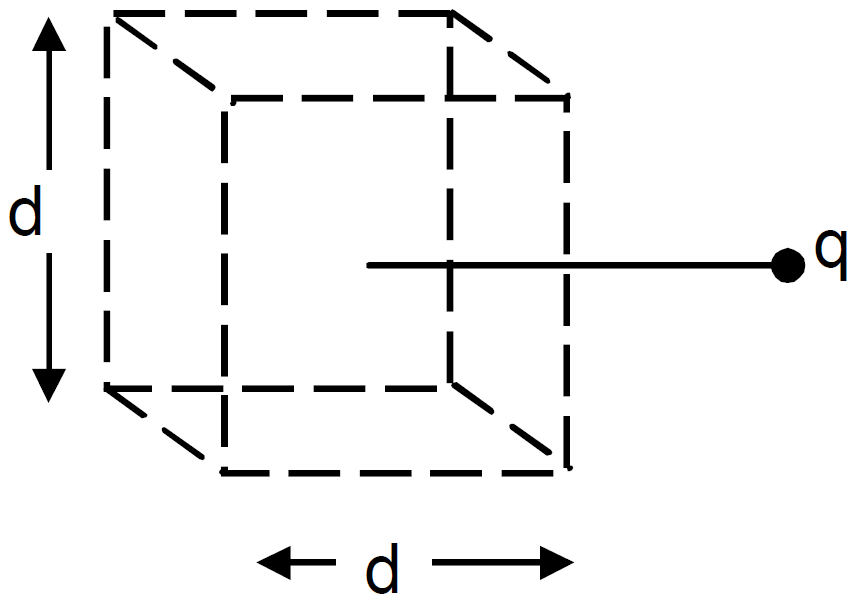
A positive charge q is placed in front of a conducting solid cube at a distance d from its centre. Find the electric field at the centre of the cube due to the charges appearing on its surface.
Answer


We know,
Electric field at a point due to a given charge
$'\text{E}'=\frac{\text{Kq}}{\text{r}^2}$ Where q = charge, r = Distance between the point and the charge
So, $'\text{E}'=\frac{1}{4\pi\in_0}\times\frac{\text{q}}{\text{d}^2}$ $[\therefore\text{r}=\text{‘d’}\text{here}]$

Need a full question paper?

Generate a complete, print-ready paper with questions like this in minutes — across 16+ boards, with answer keys.

Start Generating Free

Similar questions

A pulse travelling on a string is represented by the function:$\text{y}=\frac{\text{a}^3}{(\text{x}-\text{vt})^2+\text{a}^2},$
where a = 5mm and v = 20cm/s. Sketch the shape of the string at t = 0, 1s and 2s.Take x = 0 in the middle of the string.
Which of the following functions of time represent (a) simple harmonic, (b) periodic but not simple harmonic, and (c) non-periodic motion? Give period for each case of periodic motion ($\omega$ is any positive constant):$\sin\omega\text{t}-\cos\omega\text{t}$
The radius of a planet is $R_1$ and a satellite revolves round it in a circle of radius $R_2$. The time period of revolution is $T$. Find the acceleration due to the gravitation of the planet at its surface.
In adiabatic compression of a gas, no heat is supplied to the gas from outside, yet the temperature of gas increases it. Explain the reason.
On a hot summer day we want to cool our room by opening the refrigerator door and closing all the windows and doors. Will the process work ?
Consider a pair of identical pendulums, which oscillate with equal amplitude independently such that when one pendulum is at its extreme position making an angle of 2° to the right with the vertical, the other pendulum makes an angle of 1° to the left of the vertical. What is the phase difference between the pendulums?
Water is escaping from a vessel through a horizontal capillary tube $20cm$ long $0.2mm$ radius at a point $100cm$ below the free surface of water in the vessel. Calculate the rate of flow if coefficient of viscosity of water be $1 \times 10^{-3} Pa-s$.
What is the gravitational force on a body inside a spherical shell? Why is it so?
Find the number of molecules in $1cm^3$ of an ideal gas at 0°C and at a pressure of $10^{-5}​​​​​​​$ mm of mercury.
Pure water vapour is trapped in a vessel of volume $10cm^3$. The relative humidity is 40%. The vapour is compressed slowly and isothermally. Find the volume of the vapour at which it will start condensing.