A potentiometer consists of a wire of length $4\, m$ and resistance $10\,\Omega $. It is connected to a cell of $e.m.f.$ $2\, V$. The potential difference per unit length of the wire will be ............. $V/m$
AIPMT 1999, Easy
Download our app for free and get started
Since potential difference for full length of wire $=$ $2\, V$
$P.D.$ per unit length of wire $ = \frac{2}{4} = 0.5\,\frac{V}{m}$

Download our appand get started for free
Experience the future of education. Simply download our apps or reach out to us for more information. Let's shape the future of learning together!No signup needed.*
Similar Questions
- 1A $2\, volt$ battery, a $15\,\Omega $ resistor and a potentiometer of $100\, cm$ length, all are connected in series. If the resistance of potentiometer wire is $5\,\Omega $, then the potential gradient of the potentiometer wire is ............... $V/cm$View Solution
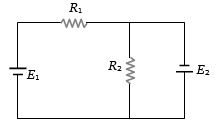
- 2Two resistances ${R_1}$ and ${R_2}$ are joined as shown in the figure to two batteries of $e.m.f.$ ${E_1}$ and ${E_2}$. If ${E_2}$ is short-circuited, the current through ${R_1}$ isView Solution
- 3$A$ battery is of $\mathrm{emf}$ $E$ is being charged from a charger such that positive terminal of the battery is connected to terminal $A$ of charger and negative terminal of the battery is connected to terminal $B$ of charger. The internal resistance of the battery is $r$.View Solution
- 4$n$ equal cell having emf $E$ and internal resistance $r$, are connected in a circuit of a resistance $R$ . Same current flows in circuit either they are connected in series or parallel, ifView Solution
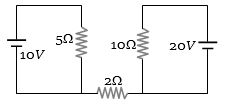
- 5Find out the value of current through $2\,\Omega$ resistance for the given circuit ............ $A$View Solution
- 6$1.6\, mA$ current is flowing in conducting wire then the number of electrons flowing per second isView Solution
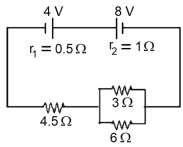
- 7In the circuit diagram shown in figure given below, the current flowing through resistance $3\, \Omega$ is $\frac{ x }{3}\,A$. The value of $x$ is $...........$View Solution
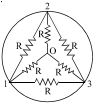
- 8Inside $a$ super conducting ring six identical resistors each of resistance $R$ are connected as shown in figure. The equivalent resistance $(s)$View Solution
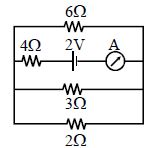
- 9The reading of the ammeter in the adjoining figure will be .............. $A$View Solution
- 10A cylindrical metal wire of length $l$ and cross sections area $S$, has resistance $R$, conductance $G$, conductivity $\sigma$ and resistivity $\rho$. Which one of the following expressions for $\sigma$ is validView Solution