Question

A potentiometer has uniform potential gradient across it.  Two cells connected in series (i) to support each other and (ii) to oppose each other are balanced over 6m and 2m respectively on the potentiometer wire.  The e.m.f.’s of the cells are in the ratio of

(a) 1 : 2

(b) 1 : 1

(c) 3 : 1

(d) 2 : 1

Answer

(d) 2 : 1

Need a full question paper?

Generate a complete, print-ready paper with questions like this in minutes — across 16+ boards, with answer keys.

Start Generating Free

Similar questions

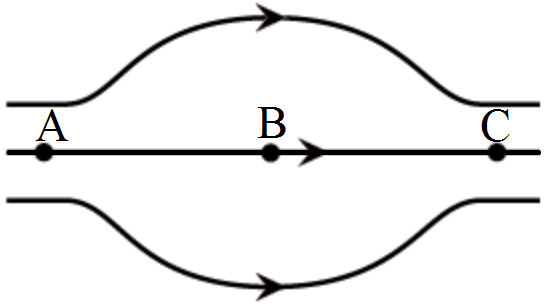
Figure, shows some of the electric field lines corresponding to an electric field. The figure suggests that,

Two parallel wires in free space are 10 cm apart and each carries a current of 10 A in the same direction. The force one wire exerts on the other per metre of length is

(a) 2 , attractive

(b) 2, repulsive

(c) 2  , attractive

(d) 2  , repulsive

Two particles X and Y having equal charge, after being accelerated through the same potential difference enter a region of uniform magnetic field and describe circular paths of radii R1 and R2 respectively. The ratio of the mass of X to that of Y is:
E.M.F. ofa cell is expressed in:

Consider the following two statements A and B, and identify the correct choice out of given answers

A. Thermo e.m.f. is minimum at neutral temperature of a thermocouple

B. When two junctions made of two different metallic wires are maintained at different temperatures, an electric current is generated in the circuit.

(a) A is false and B is true

(b) A is true and B is false

(c) Both A and B are false

(d) Both A and B are true

If a photon has velocity c and frequency n, then which of following represents its wavelength

(a)        

(b)

(c)

(d) hv

An air bubble in sphere having 4 cm diameter appears 1 cm from surface nearest to eye when looked along diameter. If amg = 1.5, the distance of bubble from refracting surface is

(a) 1.2 cm

(b) 3.2 cm

(c) 2.8 cm

(d) 1.6 cm

The phenomenon due to which a ray of light .......... from its path while travelling from one optical medium to another optical medium is called refraction.

Correct exposure for a photographic print is 10 seconds at a distance of one metre from a point source of 20 candela. For an equal fogging of the print placed at a distance of 2 m from a 16 candela source, the necessary time for exposure is

(a) 100 sec

(b) 25 sec

(c) 50 sec   

(d) 75 sec

The refractive index of a piece of transparent quartz is the greatest for

(a) Red light

(b) Violet light

(c) Green light

(d) Yellow light