Question
A power transmission line feeds input power at 2300V to a stepdown transformer with its primary windings having 4000 turns. What should be the number of turns in the secondary in order to get output power at 230 V?

Answer

Input voltage, $\mathrm{V}_1=2300$
Number of turns in primary coil, $\mathrm{n}_1=4000$
Output voltage, $\mathrm{V}_2=230 \mathrm{~V}$
Number of turns in secondary coil $=\mathrm{n}_2$
Voltage is related to the number of turns as:
$\frac{\text{V}_1}{\text{V}_2}=\frac{\text{n}_1}{\text{n}_2}$
$\frac{2300}{230}=\frac{4000}{\text{n}_2}$
$\text{n}_2=\frac{4000\times230}{2300}=400$
Hence, there are 400 turns in the second winding.

Need a full question paper?

Generate a complete, print-ready paper with questions like this in minutes — across 16+ boards, with answer keys.
Start Generating Free

Similar questions

It is found experimentally that $13.6 eV$ energy is required to separate a hydrogen atom into a proton and an electron. Compute the orbital radius and the velocity of the electron in a hydrogen atom.
Why are elemental dopants for Silicon or Germanium usually chosen from group XIII or group XV?
A force F facts on a point charge placed on the axis of an electric dipole. If the distance of a point charge from the dipole is doubled, what will be the force on it? Explain the reason also.
An electron beam projected along the positive X-axis deflects along the positive Y-axis. If this deflection is caused by a magnetic field, what is the direction of the field? Can we conclude that the field is parallel to the Z-axis?
In a series LCR circuit, the voltage across an inductor, a capacitor and a resistor are 30V, 30V and 60V respectively. What is the phase difference between the applied voltage and current in the circuit?
Taking force, length and time to be the fundamental quantities find the dimensions of:
  1. Density.
  2. Pressure.
  3. Momentum.
  4. Energy.
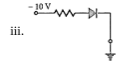
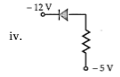
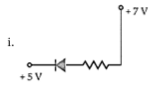
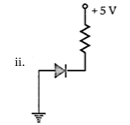
In the following diagrams indicate which of the diodes are forward biased and which are reverse biased.
Image
Image
Image
Image
A convex lens of diameter 8.0cm is used to focus a parallel beam of light of wavelength 620nm. If the light be focused at a distance of 20cm from the lens, what would be the radius of the central bright spot formed?
The wavelength $\lambda$ of a photon and the de-Broglie wavelength of an electron have the same value. Show that energy of a photon is (2$\lambda$mc/h) times the kinetic energy of electron; where m, c and h have their usual meaning.
Explain J J. Thomson's plum pudding model of atom.