MCQ
A prism is used to:
  • A
    Change the path of light by reflection and refraction both.
  • B
    Rotate the image.
  • C
    Disperse the light into its components.
  • D
    All of these.

Answer

  1. Change the path of light by reflection and refraction both.

Explanation:

Prisms are made in many different forms and shapes, depending on the application. The Porro prism, for example, consists of two prisms arranged both to invert and to reverse.

Need a full question paper?

Generate a complete, print-ready paper with questions like this in minutes — across 16+ boards, with answer keys.
Start Generating Free

Similar questions

When an electric lamp is connected to 12V battery, it draws a current of 0.5A. The Power of the lamp is:
The power of a converging lens is 4.5D and that of a diverging lens is 3D. The power of this combination of lenses placed close together is:
In order to make an efficient solar cooker, the cover of cooker box should be made of:
  1. Transparent plastic sheet.
  2. Shining aluminium sheet.
  3. Butter paper sheet.
  4. Transparent glass sheet.
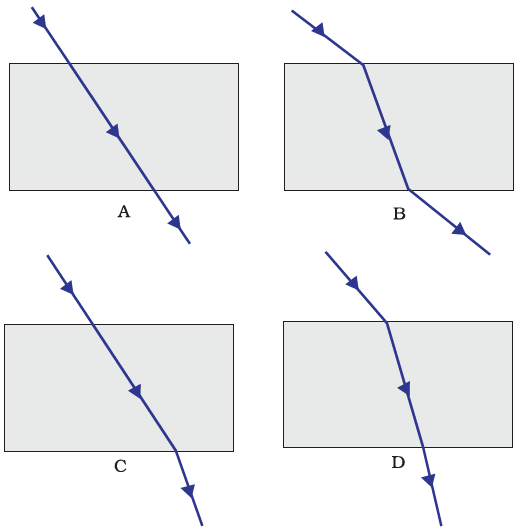
The path of a ray of light coming from air passing through a rectangular glass slab traced by four students are shown as A, B, C and D in Figure. Which one of them is correct?
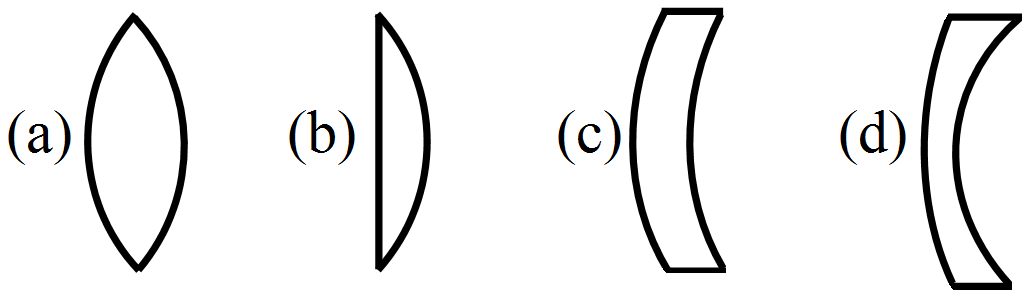
For a healthy eye, the rays of light entering the eye form a sharp image on retina. For a myopic eye, the rays from distant objects focus in front of the retina forming a blurred image. Which of the following lenses shown below will help to correct myopia?
Which of the following option has no effect on an electric fuse wire?
The focal lengths of four convex lenses P, Q, R and S are 20cm, 15cm, 5cm and 10cm, respectively. The lens having greatest power is:
In a convex spherical mirror, reflection of light takes place at:
In an experiment to trace the path of a ray of light through a triangular glass prism, a student would observe that the emergent ray.
The refractive indices of four materials A, B, C and D are 1.33, 1.43, 1.71 and 1.52 respectively. When the light rays pass from air into these materials, they refract the maximum in:
  1. Material A.
  2. Material B.
  3. Material C.
  4. Material D.