MCQ
A projectile is projected from ground with initial velocity $\vec u\, = \,{u_0}\hat i\, + \,{v_0}\hat j\,$. If acceleration due to gravity $(g)$  is along the negative $y-$ direction then find maximum displacement in $x-$ direction
  • A
    $\frac {u_0^2}{2g}$
  • $\frac {2u_0v_0}{g}$
  • C
    $\frac {v_0^2}{2g}$
  • D
    $\frac {4u_0v_0}{g}$

Answer

Correct option: B.
$\frac {2u_0v_0}{g}$
b
Given,

$\overrightarrow{ U }=u_0 \hat{1}+v_0 \hat{j}$

$u_0=u \cos \theta \ldots \ldots .1$

$v_0=v \sin \theta \ldots \ldots . .2$

Since,

$R =\frac{ u ^2 2 \sin 2 \theta}{ g }$

$R =\frac{ u ^2 2(\sin \theta \cdot \cos \theta)}{ g } \ldots \ldots$

Substituting the value of equation 1,2 in eqyuation 3 then we get,

$R =\frac{2 u _0 v _0}{ g }$

Need a full question paper?

Generate a complete, print-ready paper with questions like this in minutes — across 16+ boards, with answer keys.

Start Generating Free

Similar questions

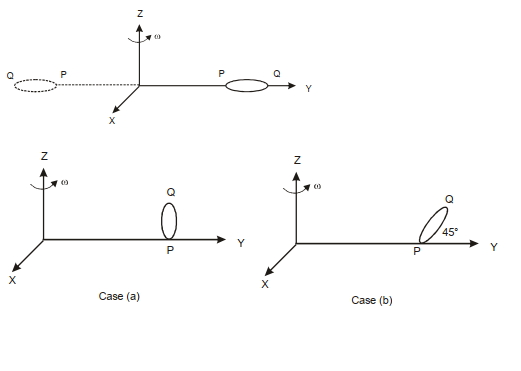
The general motion of a rigid body can be considered to be a combination of $(i)$ a motioon --- centre of mass about an axis, and $(ii)$ its motion about an instantanneous axis passing through center of mass. These axes need not be stationary. Consider, for example, a thin uniform welded (rigidly fixed) horizontally at its rim to a massless stick, as shown in the figure. Where disc-stick system is rotated about the origin ona horizontal frictionless plane with angular sp--- $\omega$, the motion at any instant can be taken as a combination of $(i)$ a rotation of the centre of mass the disc about the $z$-axis, and $(ii)$ a rotation of the disc through an instantaneous vertical axis pass through its centre of mass (as is seen from the changed orientation of points $P$ and $Q$). Both the motions have the same angular speed $\omega$ in the case. $Image$  Now consider two similar systems as shown in the figure: case $(a)$ the disc with its face ver--- and parallel to $x - z$ plane; Case $(b)$ the disc with its face making an angle of $45^{\circ}$ with $x$-y plane its horizontal diameter parallel to $x$-axis. In both the cases, the disc is weleded at point $P$, and systems are rotated with constant angular speed $\omega$ about the $z$-axis.$Image$

$1.$ Which of the following statement regarding the angular speed about the istantaneous axis (passing through the centre of mass) is correct?

$(A)$ It is $\sqrt{2} \omega$ for boht the cases

$(B)$ it is $\omega$ for case $(a)$; and $\frac{w}{\sqrt{2}}$ for case $(b)$.

$(C)$ It is $\omega$ for case $(a)$; and $\sqrt{2} \omega$ for case $(b)$.

$(D)$ It is $\omega$ for both the cases

$2.$ Which of the following statements about the instantaneous axis (passing through the centre of mass) is correct?

$(A)$ It is vertical for both the cases $(a)$ and $(b)$.

$(B)$ It is verticle for case $(a)$; and is at $45^{\circ}$ to the $x-z$ plane and lies in the plane of the disc for case $(b)$

$(C)$ It is horizontal ofr case $(a)$; and is at $45^{\circ}$ to the $x - z$ plane and is normal to the plane of the disc for case $(b)$.

$(D)$ It is vertical of case $(a)$; and is at $45^{\circ}$ to the $x - z$ plane and is normal to the plane of the disc for case $(b)$.

Give the answer question $1$ and $2.$
A projectile projected at an angle ${30^o}$ from the horizontal has a range $2\upsilon ,\,\sqrt 2 \upsilon \,\,{\rm{ and}}\,{\rm{zero}}$. If the angle of projection at the same initial velocity be ${60^o}$, then the range will be
Two stones are projected so as to reach the same distance from the point of projection on a horizontal surface. The maximum height reached by one exceeds the other by an amount equal to half the sum of the height attained by them. Then, angle of projection of the stone which attains smaller height is $........$
There is some liquid in a closed bottle. The amount of liquid is continuously decreasing. The vapour in the remaining part:
  1. Must be saturated.
  2. Must be unsaturated.
  3. May be saturated.
  4. There will be no vapour.
One mole of an ideal monoatomic gas undergoes the following four reversible processes:

Step $1$ It is first compressed adiabatically from volume $V_{1}$ to $1 \;m ^{3}$.

Step $2$ Then expanded isothermally to volume $10 \;m ^{3}$.

Step $3$ Then expanded adiabatically to volume $V _{3}$.

Step $4$ Then compressed isothermally to volume $V_{1}$. If the efficiency of the above cycle is $3 / 4$, then $V_{1}$ is ............ $m^3$

$1\  mole$ of a gas with $\gamma$ = $7/5$ is mixed with $1\  mole$ of a gas with $\gamma$ = $5/3$, then the value of $\gamma$  for the resulting mixture is
The ratio of specific heat capacity to molar heat capacity of a body:
  1. Is a universal constant.
  2. Depends on the mass of the body.
  3. Depends on the molecular weight of the body.
  4. Is dimensionless.
A circular disc is rolling on a horizontal plane. Its total kinetic energy is  $300\,\,J.$  ......... $J$ is its translational  $K.E.$
A player caught a cricket ball of mass $150\, gm$ moving at the rate of $20 \,m/sec$. if the catching process be completed in $ 0.1 \,sec$ the force of the blow exerted by the ball on the hands of player is  ........... $N$
A ball is dropped from a height of $5\,\,m$  onto a sandy floor and penetrates the sand up to $1\,\,m$  before coming to rest. The retardation of the ball in sand (assuming it to be uniform) will be ................ $\mathrm{m}/ \mathrm{s}^2$