Question
A projectile is projected horizontally with a velocity u. Show that its trajectory is parabolic. And obtain expressions for:
i. Time of flight
ii. Horizontal range
iii. Velocity at any instant $t$.
Answer

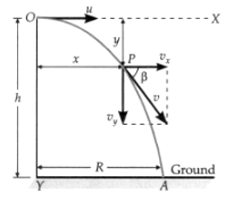
Projectile fired parallel to horizontal. As shown in figure, suppose a body is projected horizontally with velocity u from a point O at a certain height h above the ground level. The body is under the influence of two simultaneous independent motions:
i. Uniform horizontal velocity u.
ii. Vertically downward accelerated motion with constant acceleration g.
Under the combined effect of the above two motions, the body moves along the path OPA.
Image
Horizontal projection of a projectile.
Trajectory of the projectile. After the time $t$, suppose the body reaches the point P (x, y).
The horizontal distance covered by the body in time $t$ is
$
x=\text { ut } \therefore t=\frac{x}{u}
$
The vertical distance travelled by the body in time $t$ is given by
$
s=u t+\frac{1}{2} a t^2
$
or $y =0 \times t+\frac{1}{2} g t^2=\frac{1}{2} g t^2$ [For vertical motion, $u =0$ ]
or $y=\frac{1}{2} g\left(\frac{x}{u}\right)^2=\left(\frac{g}{2 u^2}\right) x^2\left[\because t=\frac{x}{u}\right]$
or $y = kx ^2$ [Here $k =\frac{g}{2 u^2}=$ a constant $]$
As $y$ is a quadratic function of $x$, so the trajectory of the projectile is a parabola.
Time of flight. It is the total time for which the projectile remains in its flight (from O to A ). Let T be its time of flight.
For the vertical downward motion of the body, we use
$s=u t+\frac{1}{2} a t^2$ or $h =0 \times T+\frac{1}{2} g T^2$
or $T-\sqrt{\frac{2 h}{g}}$
Horizontal range. It is the horizontal distance covered by the projectile during its time of flight. It is equal to $O A=R$. Thus $R =$ Horizontal velocity $\times$ time of flight $= u \times T$
or $R =u \sqrt{\frac{2 h}{g}}$
Velocity of the projectile at any instant. At the instant $t$ (when the body is at point P ), let the velocity of the projectile be v . The velocity v has two rectangular components:
Horizontal component of velocity, $v _{ x }= u$
Vertical component of velocity, $v _{ y }=0+ gt = gt$
$\therefore$ The resultant velocity at point $P$ is
$
v=\sqrt{v_x^2+v_y^2}=\sqrt{u^2+g^2 t^2}
$
If the velocity v makes an angle p with the horizontal, then $\tan \beta=\frac{v_y}{v_x}=\frac{g t}{u}$
or $\beta=\tan ^{-1}\left(\frac{g t}{u}\right)$

Need a full question paper?

Generate a complete, print-ready paper with questions like this in minutes — across 16+ boards, with answer keys.

Start Generating Free

Similar questions

Write Newton's formula for the speed of sound in air. Discuss the correction made by Laplace in this formula.
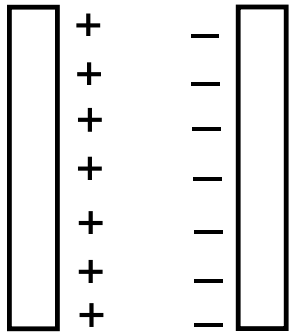
Two large conducting plates are placed parallel to each other and they carry equal and opposite charges with surface density $\sigma$ as shown in figure. Find the electric field:
  1. At the left of the plates.
  2. In between the plates.
  3. At the right of the plates.

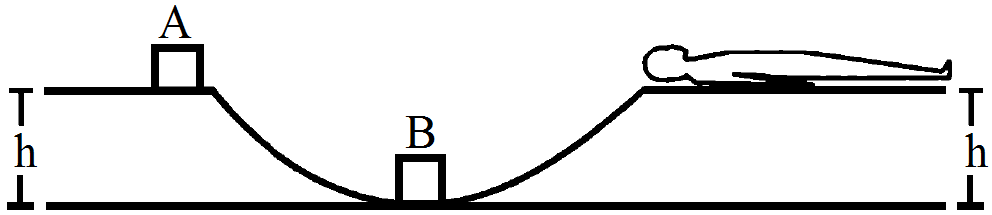
The track shown in figure is frictionless. The block B of mass 2m is lying at rest and the block A of mass m is pushed along the track with some speed. The collision between A and B is perfectly elastic. With what velocity should the block A be started to get the sleeping man awakened?

$\text{ }^{212}_{33}\text{Bi}$ can disintegrate either by emitting an $\alpha$-particle of by emitting a $\beta^-$-particle.
  1. Write the two equations showing the products of the decays.
  2. The probabilities of disintegration $\alpha$ and $\beta$ -decays are in the ratio $\frac{7}{13}.$ The overall half-life of 212Bi is one hour. If 1g of pure 212Bi is taken at 12.00 noon, what will be the composition of this sample at 1P.m. the same day?
  1. State first law of thermodynamics. What are its limitations? Why Cp > Cv?
  2. An electric heater supplies heat to a system at a rate 100W. If the system performs work at a rate of 75 joules per second at what rate is the internal energy increases.

OR

  1. Derive an expression for the work done during the isothermal expression of x mole of an ideal gas.
  2. A steam engine delivers 5.4 × 10⁸J of work per minute and services 3.6 × 10⁹J of heat per minute from its boiler. What is the efficiency of the engine? How much heat is wasted per minute?
A mass m is left free at a distance 3R from the surface of earth. On reaching the surface, what will be its velocity?
Considering the pressure p to be proportional to the density, find the pressure p at a height h if the pressure on the surface of the earth is p0.
Show that in the case of a closed organ pipe, the ratio of the frequencies of the harmonics is 1 : 3 : 5 : 7.
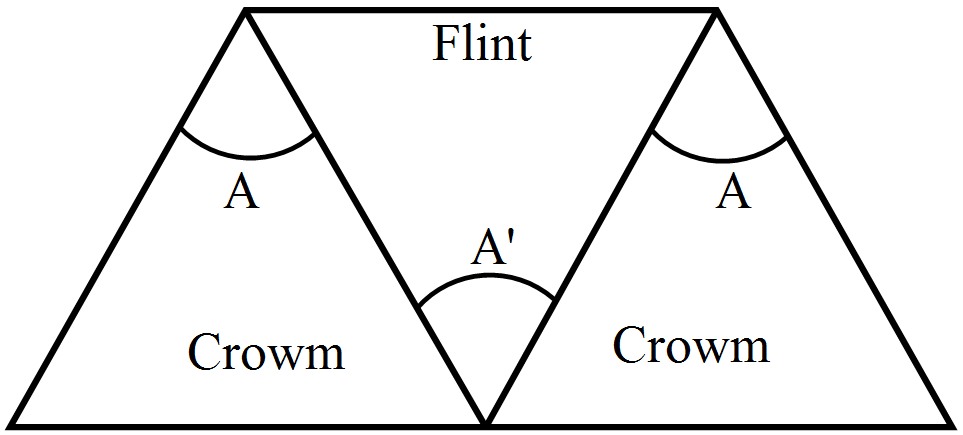
Three thin prisms are combined as shown in figure. The refractive indices of the crown glass for red, yellow and violet rays are $\mu_\text{r},\mu_\text{y}$ and $\mu_\text{v}$ respectively and those for the flint glass are $\mu'_\text{r},\mu'_\text{y}$ and $\mu'_\text{v}$ respectively. Find the ratio $\frac{\text{A}'}{\text{A}}$ for which.

  1. There is no net angular dispersion.
  2. There is no net deviation in the yellow ray.
Explain the angle of friction and angle of repose.