Question
A projectile is projected with kinetic energy $K$. If it has the maximum possible horizontal range, then its kinetic energy at the highest point will be ......... $K$

Answer

since, range is maximum, therefore $\theta=45^{\circ}$

Hence, $v_{x}=v \cos 45^{\circ}=v / \sqrt{2} .$ At the highest

point, the net velocity of the projectile is

$v_{x}=v \cos 45^{\circ}$

$\therefore \quad \mathrm{KE}=\frac{1}{2} \mathrm{mv}_{\mathrm{x}}^{2}=\frac{1}{2} \mathrm{m} \frac{\mathrm{v}^{2}}{2}=\frac{\mathrm{K}}{2}=0.5 \mathrm{K}$

Need a full question paper?

Generate a complete, print-ready paper with questions like this in minutes — across 16+ boards, with answer keys.

Start Generating Free

Similar questions

Sir $C.V.$ Raman was awarded Nobel Prize for his work connected with which of the following phenomenon of radiation
Assertion : The colour of the green flower seen through red glass appears to be dark.

Reason : Red glass transmits only red light.
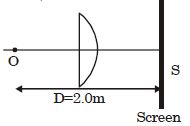
A plano-convex thin lens is used to obtain the image of a point object $O$ on the screen $S$ as shown in figure. The thickness of the lens in the middle is $0.5\ cm$ and refractive index of the material of the lens is $1.5$ . If the separation $D$ between the object and the screen is to be minimum, then the aperture diameter of the lens should be.....$cm$ (consider lens as thin)
Two waves having equations

${x_1} = a\sin (\omega \,t + {\phi _1})$, ${x_2} = a\sin \,(\omega \,t + {\phi _2})$

If in the resultant wave the frequency and amplitude remain equal to those of superimposing waves. Then phase difference between them is
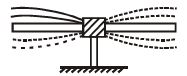
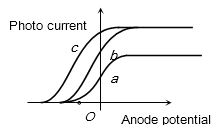
Image of an object approaching a convex mirror of radius of curvature $20\  m$ along its optical axis is observed to move from $\frac{{25}}{3}\ m$ to $\frac{{25}}{3}\ m$ in $30\  seconds$. What is the speed of the object in $km$ per hour ?
In a cyclotron, the angular frequency of a charged particle is independent of
The spectrum of iodine gas under white light will be
A rod of length $1.2\,m$ is clamped at the mid point and its fundamental frequency is $2\,MHz$ , then speed of wave inside the rod?
The figure shows the variation of photocurrent with anode potential for a photo-sensitive surface for three different radiations.Let ${I_a},\;{I_b}$and ${I_c}$ be the intensities and ${f_a},\;{f_b}$ and ${f_c}$ be the frequencies for the curves $a, b$ and $c$ respectively
To distinguish between formaldehyde and acetaldehyde, we require