MCQ
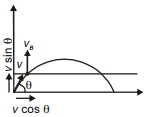
A projectile is thrown with velocity $v$ at an angle $\theta$ with horizontal. When the projectile is at a height equal to half of the maximum height, the vertical component of the velocity of projectile is ...........
  • A
    $v \sin \theta \times 3$
  • B
    $\frac{v \sin \theta}{3}$
  • $\frac{v \sin \theta}{\sqrt{2}}$
  • D
    $\frac{v \sin \theta}{\sqrt{3}}$

Answer

Correct option: C.
$\frac{v \sin \theta}{\sqrt{2}}$
c
(c)

$v_B^2=v^2 \sin ^2 \theta-\frac{2 g}{2}\left(\frac{u^2 \sin ^2 \theta}{2 g}\right)$

$v_B^2=\frac{v^2 \sin ^2 \theta}{2}$

$v_B=\frac{v \sin \theta}{\sqrt{2}}$

Need a full question paper?

Generate a complete, print-ready paper with questions like this in minutes — across 16+ boards, with answer keys.

Start Generating Free

Similar questions

A car accelerates from rest at a constant rate $\alpha$ for some time after which it decelerates at a constant rate $\beta$ to come to rest. If the total time elapsed is $t$ seconds, the total distance travelled is
A uniform chain of length $L$ which hanges partially from a table, is kept in equilibrium by friction. The maximum length that can withstand without slipping is $l$ , then coefficient of friction between the table and the chain is
The potential energy of a system increases if work is done
In an elastic collision between disks $A$ and $B$ of equal mass but unequal radii, $A$ moves along the $x$ -axis and $B$ is stationary before impact. Which of the following is possible after impact?
A disc of radius $2\; \mathrm{m}$ and mass $100\; \mathrm{kg}$ rolls on a horizontal floor. Its centre of mass has speed of $20\; \mathrm{cm} / \mathrm{s} .$ How much work is needed to stop it?
A projectile has the same range $R$ for two angles of projection. If $T_1$ and $T_2$ be the times of flight in the two cases, then $R$ is
A force of 200N is required to push a car of mass 500kg slowly at constant speed on a level road. If a force of 500N is applied, the acceleration of the car (in ms-2) will be:
According to atomic hypothesis:
One end of a massless spring of spring constant $k$ and natural length $l_{0}$ is fixed while the other end is connected to a small object of mass $m$ lying on a frictionless table. The spring remains horizontal on the table. If the object is made to rotate at an angular velocity $\omega$ about an axis passing through fixed end, then the elongation of the spring will be
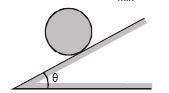
A hollow sphere of mass $m$ filled with a non-viscous liquid of same mass $m$ is released on a slope inclined at angle $q$ with the horizontal. The friction between the sphere and the slope is sufficient to prevent sliding and frictional forces between the inner surface of the sphere and the liquid is negligible. After descending a certain height ratio of translational and rotational kinetic energies is found to be $x:y$, find the numerical value of expression $(x+y)_{min}.$