MCQ
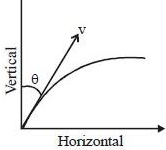
A projectile thrown with velocity $v$ making angle $\theta$ with vertical gains maximum height $H$ in the time for which the projectile remains in air, the time period is
  • A
    $\sqrt {H\,\cos \,\theta /g} $
  • B
    $\sqrt {2H\,\cos \,\theta /g} $
  • C
    $\sqrt {4H/g} $
  • $\sqrt {8H/g} $

Answer

Correct option: D.
$\sqrt {8H/g} $
d
$\begin{array}{l}
Max.\,height = H = \frac{{{v^2}{{\sin }^2}\left( {90 - \theta } \right)}}{{2g}}\,\,\,....\left( i \right)\\
Time\,of\,flight,\,T = \frac{{2\,v\,\sin \left( {90 - \theta } \right)}}{g}\,\,\,\,\,...\left( {ii} \right)\\
From\left( i \right),\,\frac{{v\,\cos \,\theta }}{g} = \sqrt {\frac{{2H}}{g}} \,From\,\left( {ii} \right),\\
T = 2\sqrt {\frac{{2H}}{g}}  = \sqrt {\frac{{8H}}{g}} .
\end{array}$

Need a full question paper?

Generate a complete, print-ready paper with questions like this in minutes — across 16+ boards, with answer keys.

Start Generating Free

Similar questions

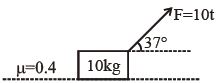
A force acts on a block as shown in figure. Find time when block loses contact with surface.
A sphere rolls down on an inclined plane of inclination $q$.  What is the acceleration as the sphere reaches bottom           
If force $(F)$, length $(L)  $ and time $(T)$ are assumed to be fundamental units, then the dimensional formula of the mass will be
Bullets of mass $50g$ are fired from a gun of mass $10 \,kg$ with velocity of $300\, m/s$. If $5\, bullets$ are fired per second then what force a person will have to apply on the gun  so that it does not recoil ............ $N$
In a streamline flow:
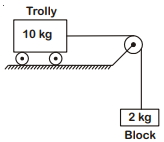
Calculate the acceleration (In $m/s^{2}$) of the block and trolly system shown in the figure. The coefficient of kinetic friction between the trolly and the surface is $0.05 .\left( g =10\; m / s ^{2},\right.$ mass of the string is negligible and no other friction exists).
The centre of mass of a system particles does not depend on:
A disc is rotating with an angular speed of $\omega$.  If a child sits on it, which of the following is conserved
A point source emits sound equally in all directions in a non-absorbing medium. Two points P and Qare at distances of 2 m and 3 m respectively from the source. The ratio of the intensities of the waves at P and Q is:
A glass flask is filled up to a mark with $50\, cc$ of mercury at $18°C.$ If the flask and contents are heated to $38°C.$ ......... $cc$ mercury will be above the mark $?$ $(\alpha$ for glass is $ 9 × 10^{-6}{°}C^{-1}$ and coefficient of real expansion of mercury is $180 × 10^{-6}{°}C^{-1})$