Question

A proton accelerated by a potential difference 500 KV moves though a transverse magnetic field of 0.51T as shown in figure. The angle θ through which the proton deviates from the initial direction of its motion is
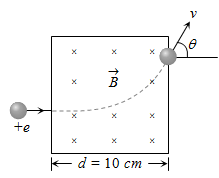
(a) 15°

(b) 30°

(c) 45°

(d) 60°

Answer

(b) 30°

Need a full question paper?

Generate a complete, print-ready paper with questions like this in minutes — across 16+ boards, with answer keys.

Start Generating Free

Similar questions

What is mainly measured by potentiometer ?
For small currents, ‘X’ obeys Ohm’s law. But when large currents are passed through the same conductor, it deviates from ohmic behaviour. Identify X.
A thin transparent sheet is placed in front of a Young's double slit. The fringe-width will:
  1. Increase.
  2. Decrease.
  3. Remain same.
  4. Become nonuniform.

Field inside a solenoid is

(a) Directly proportional to its length

(b) Directly proportional to current

(c) Inversely proportional to total number of turns

(d) Inversely proportional to current

Faraday's laws of electrolysis are related to

(a) The atomic number of positive ion

(b) The equivalent weight of electrolyte

(c) The atomic number of negative ion

(d) The velocity of positive ion

A uniform magnetic field B is acting from south to north and is of magnitude 1.5 . If a proton having mass  = 1.7   and charge  = 1.6   moves in this field vertically downwards with energy 5 MeV, then the force acting on it will be

(a) 7.4  

(b) 7.4  

(c) 7.4  

(d) 7.4  

Which of the following statements concerning the depletion zone of an unbiased PN junction is (are) true

(a) The width of the zone is independent of the densities of the dopants (impurities)

(b) The width of the zone is dependent on the densities of the dopants

(c) The electric field in the zone is produced by the ionized dopant atoms

(d) b, c

If identical charges (-q) are placed at each corner of a cube of side b, then electric potential energy of charge (+q)  which is placed at centre of the cube will be

(a)  

(b)

(c)

(d)

A paramagnet magnet behaves like a solenoid because both contain currents in the form of:

To charges  and  are placed 30 cm apart, shown in the figure. A third charge  is moved along the arc of a circle of radius 40 cm  from C  to D. The change in the potential energy of the system is , where k  is

(a) 8 

(b)  

(c)  

(d)