Question
A proton and a deuteron are accelerated through the same accelerating potential. Which one of the two has,
  1. greater value of de-Broglie wavelength associated with it, and
  2. less momentum?
Give reasons to justify your answer.

Answer

  1. de Broglie wavelength is given by

$\lambda = \frac{\text{h}}{\sqrt{2\text{mqV}}}$

As mass of proton < mass of deuteron and qp = qd and v is same

$\Rightarrow\lambda_{p} > \lambda_{d}$ for same accelerating potential.

  1. Momentum $ = \frac{\text{h}}{\lambda}$

$\because\lambda_{p}> \lambda_{d}$

 $\therefore$ momentum o proton will be less, than that of deuteron.

Need a full question paper?

Generate a complete, print-ready paper with questions like this in minutes — across 16+ boards, with answer keys.

Start Generating Free

Similar questions

Define volume density of charge and write its S.I. unit ?
Write the definition of wave front.
According to Maxwell's theory of electrodynamics, an electron going in a circle should emit radiation of frequency equal to its frequency of revolution. What should be the wavelength of the radiation emitted by a hydrogen atom in ground state if this rule is followed?
The dielectric constant of the medium filled between the spheres of a spherical capacitor is 7. The radii of its spheres are 50 cm and 60 cm respectively. Find the value of capacitance of the capacitor.
Answer the following question:
Every metal has a definite work function. Why do all photoelectrons not come out with the same energy if incident radiation is monochromatic? Why is there an energy distribution of photoelectrons?
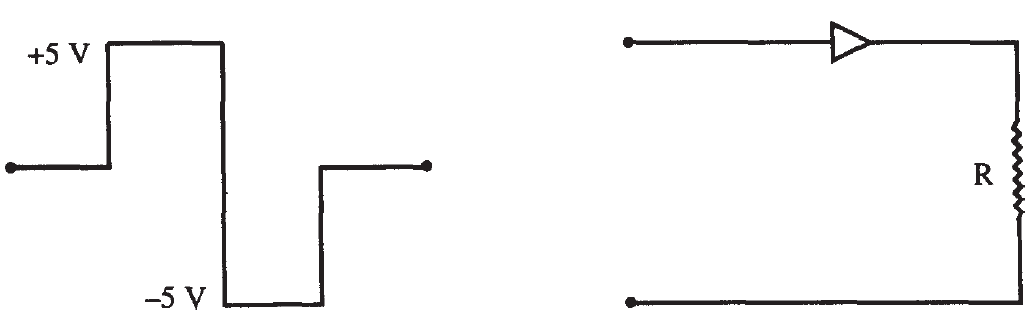
Draw and explain the output waveform across the load resistor R, if the input waveform is as shown in the given figure.

The equation of refraction at a spherical surface is $\frac{\mu_2}{\text{v}}-\frac{\mu_1}{\text{u}}-=\frac{\mu_2-\mu_1}{\text{R}}.$ Taking $\text{R}=\infty,$ show that this equation leads to the equation $\frac{\text{Real depth}}{\text{Apparent depth}}=\frac{\mu_2}{\mu_1}$ for refraction at a plane surface.
An electric field $\vec{\text{E}}=\vec{\text{i}}\text{Ax}$ exists in the space, where A= 10Vm-2. Take the potential at (10m, 20m) to be zero. Find the potential at the origin.
Can the voltage drop across the inductor or the capacitor in a series LCR circuit be greater than the applied voltage of the a.c. source? Justify your answer.
Find the maximum wavelength of electromagnetic radiation which can create a hole-electron pair in germanium. The band gap in germanium is 0.65eV.