- A$\sqrt 2\,R$
- ✓$\frac{R}{{\sqrt 2 }}$
- C$\frac{R}{{2 }}$
- D$R$
Energy acquired by both, $E=e V$ For Deuteron.
Kinetic energy, $\frac{1}{2} m V^{2}=e V$
[ $V$ is the potential difference]
$v = \sqrt {\frac{{2eV}}{{{m_d}}}} $
But $m_{d}=2 m$
Therefore, $v=\sqrt{\frac{2 e V}{2 m}}=\sqrt{\frac{e V}{m}}$
Radius of path, $R=\frac{m v}{e B}$
Substituting value of $'V'$ we get
$R = \frac{{2m\sqrt {\frac{{ev}}{m}} }}{{eB}}$
$\frac{R}{2}=\frac{m \sqrt{\frac{e v}{m}}}{e B}$ .... $(i)$
For proton :
$\frac{1}{2} m V^{2}=e V$
$v=\sqrt{\frac{2 e V}{m}}$
Radius of path, $R' = \frac{{mV}}{{eB}} = \frac{{m\sqrt {\frac{{2eV}}{m}} }}{{eB}}$
$R = \sqrt 2 \times \frac{R}{2}$ [From eq. $(i)$ ]
$R' = \frac{R}{{\sqrt 2 }}$
Generate a complete, print-ready paper with questions like this in minutes — across 16+ boards, with answer keys.

Statement$-II :$ To get a steady de output from the pulsating voltage received from a full wave rectifier we can connect an inductor in series with ${R}_{{L}}$.
In the light of the above statements, choose the most appropriate answer from the options given below:
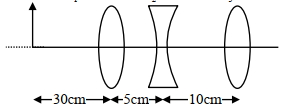
$\mathrm{f}_1=10 \mathrm{~cm} \quad \mathrm{f}_2=10 \quad \mathrm{f}_3=30 \mathrm{~cm}$