Question
A proton and an α-particle are accelerated, using the same potential difference. How are the de-Broglie wavelengths λp and λa related to each other?

Answer

Key concept: Hence de-Broglie wavelength:

$\lambda=\frac{\text{h}}{\text{p}}=\frac{\text{h}}{\sqrt{2\text{mE}}}=\frac{\text{h}}{\sqrt{2\text{mqV}}}$

In this problrm since both proton and $\alpha-\text{particle}$ are accelerated through same potential difference,

We know that, $\lambda=\frac{\text{h}}{\sqrt{2\text{mqv}}}$

$\therefore\ \lambda\propto\frac{1}{\sqrt{\text{mq}}}$

$\frac{\lambda_\text{p}}{\lambda_\alpha}=\frac{\sqrt{\text{m}_\alpha\text{q}_\alpha}}{\text{m}_\text{p}\text{q}_\text{p}}=\frac{\sqrt{4\text{m}_\text{p}\times2\text{e}}}{\sqrt{\text{m}_\text{p}\times\text{e}}}=\sqrt{8}$

$\therefore\ \lambda_\text{p}=\sqrt{8}\lambda_\alpha$

i.e., wavelength of proton is times wavelength of $\alpha-\text{particle}$.

Important point:

De-Broglie wavelength associated with the charged particles: The energy of a charged particle acceletated through potential difference V is

$\text{E}=\frac{1}{2}\text{mv}^2=\text{qV}$

Hence de-Broglie wavelength $\lambda=\frac{\text{h}}{\text{p}}=\frac{\text{h}}{\sqrt{2\text{mE}}}=\frac{\text{h}}{\sqrt{2\text{mqV}}}$

$\lambda_\text{Electron}=\frac{12.27}{\sqrt{\text{V}}}\mathring{\text{A}},\lambda_\text{Proton}=\frac{0.286}{\sqrt{\text{V}}}\mathring{\text{A}}$

$\lambda_\text{Deutron}=\frac{0.200}{\sqrt{\text{V}}}\mathring{\text{A}},\lambda_{\alpha-\text{particle}}=\frac{0.101}{\sqrt{\text{V}}}\mathring{\text{A}}$

Need a full question paper?

Generate a complete, print-ready paper with questions like this in minutes — across 16+ boards, with answer keys.
Start Generating Free

Similar questions

A piece of iron of mass 100g is kept inside a furnace for a long time and then put in a calorimeter of water equivalent 10g containing 240g of water at 20°C. The mixture attains and equilibrium temperature of 60°C. Find the temperature of the furnace. Specific heat capacity of iron = 470J kg-1°C-1.
In a plane electromagnetic wave, the electric field oscillates sinusoidally at a frequency of 2.0 × 10¹⁰ Hz and amplitude 48 V m-1.
  1. What is the wavelength of the wave?
  2. What is the amplitude of the oscillating magnetic field?
  3. Show that the average energy density of the E field equals the average energy density of the B field. [c = 3 × 10⁸ m s-1.]
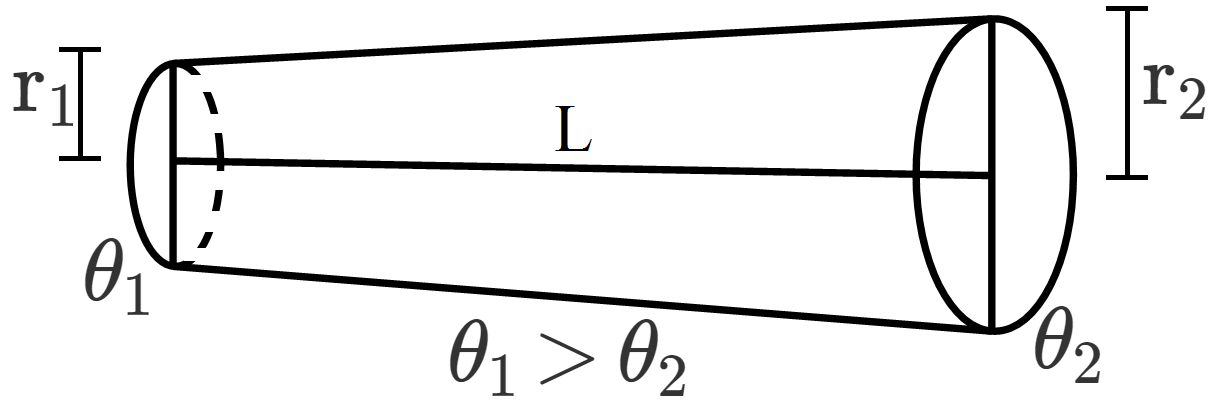
Find the rate of heat flow through a cross section of the rod shown in figure, $\big(\theta_2>\theta_1\big).$ Thermal conductivity of the material of the rod is K.

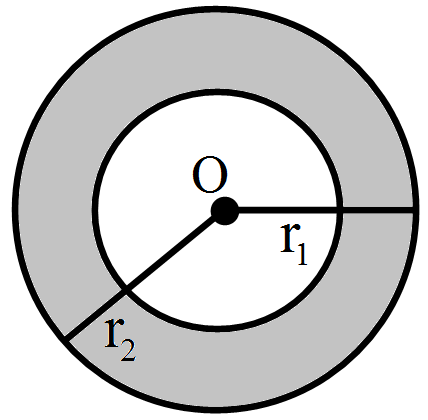
A charge Q is distributed uniformly within the material of a hollow sphere of inner and outer radii r1 and r2 (figure). Find the electric field at a point P a distance x away from the centre for r1 < x < r2 Draw a rough graph showing the electric field as a function of x for O < x < 2r2 (figure).

Two point charges $q$ and $-q$ are located at points $(0,0,-a)$ and $(0,0, a)$ respectively.
i. Find the electrostatic potential at $(0,0, z)$ and $(x, y, 0)$.
ii. How much work is done in moving a small test charge from the point $(5,0,0)$ to $(-7,0,0)$ along the $X$-axis?
iii. How would your answer change if the path of the test charge between the same points is not along the $x$-axis but along any other random path?
iv. If the above point charges are now placed in the same positions in a uniform external electric field $\vec{E}$, what would be the potential energy of the charge system in its orientation of unstable equilibrium? Justify your answer in each case.
The wavelength of sodium light in air is 589nm.
  1. Find its frequency in air.
  2. Find its wavelength in water (refractive index = 1.33).
  3. Find its frequency in water.
  4. Find its speed in water.
Draw a ray diagram of image formation by a concave mirror and establish the relation between object distance $(u)$, image distance ($v$) and focal length $(f)$.
Five charges, q each are placed at the corners of a regular pentagon of side 'a' (Fig.).

  1.  
  1. What will be the electric field at O, the centre of the pentagon?
  2. What will be the electric field at O if the charge from one of the corners (say A) is removed?
  3. What will be the electric field at O if the charge q at A is replaced by -q?
  1. How would your answer to (a) be affected if pentagon is replaced by n-sided regular polygon with charge q at each of its corners?
  1. Draw a labelled ray diagram showing the formation of image by a compound microscope in normal adjustment. Derive the expression for its magnifying power.
  2. How does the resolving power of a microscope change when.
  1. The diameter of the objective lens is decreased,
  2. The wavelength of the incident light is increased.

Justify your answer in each case.