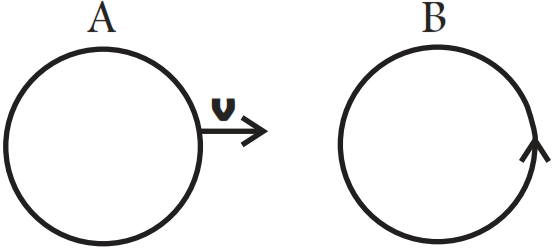
- A$\lambda_\text{e}=\lambda_\text{p}.$
- B$\lambda_\text{e}<\lambda_\text{p}.$
- C$\lambda _\text{e}>\lambda_\text{p}.$
- DThe relation between $\lambda_\text{e}$, and $\lambda_\text{p}$ depends on the accelerating potential difference.

Explanation:
Let me and mp be the masses of electron and proton, respectively.
Let the applied potential difference be V.
Thus, the de-Broglie wavelength of the electron,
$\lambda=\frac{\text{h}}{\sqrt{2\text{m}_\text{e}\text{eV}}}\dots(1)$
And de-Broglie wavelength of the proton,
$\lambda=\frac{\text{h}}{\sqrt{2\text{m}_\text{p}\text{eV}}}\dots(2)$
Dividing equation (2) by equation (1), we get:
$\frac{\lambda_\text{p}}{\lambda_\text{e}}=\frac{\sqrt{\text{m}_\text{e}}}{\sqrt{\text{m}_\text{p}}}$
$\text{m}_\text{e}<\text{m}_\text{p}$
$\therefore\frac{\lambda_\text{p}}{\lambda_\text{e}}<1$
$\Rightarrow\lambda_ \text{p}<\lambda_\text{e}$
Generate a complete, print-ready paper with questions like this in minutes — across 16+ boards, with answer keys.
Stars are twinkling due to
|
(a) Diffraction |
(b) Reflection |
(c) Refraction |
(d) Scattering |
The specific charge of an electron is
|
(a) 1.6 |
(b) 4.8 |
|
(c) 1.76 |
(d) 1.76 |
The resistance of a conductor increases with
|
(a) Increase in length |
(b) Increase in temperature |
|
(c) Decrease in cross–sectional area |
(d) All of these |
Atom bomb consists of two pieces of
and a source of
|
(a) Proton |
(b) Neutron |
(c) Meson |
(d) Electron |

How should people wearing spectacles work with a microscope
|
(a) They cannot use the microscope at all |
(b) They should keep on wearing their spectacles |
|
(c) They should take off spectacles |
(d) (b) and (c) is both way |