MCQ
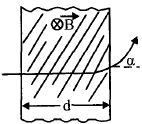
A proton (mass $m$ ) accelerated by a potential difference $V$  flies through a uniform transverse magnetic field $B.$ The field occupies a region of space by width $'d'$. If $\alpha $ be the angle of deviation of proton from initial direction of motion (see figure), the value of $sin\,\alpha $ will be
  • A
    $qV\,\sqrt {\frac{{Bd}}{{2m}}} $
  • B
    $\frac{B}{2}\sqrt {\frac{{qd}}{{mV}}} $
  • C
    $\frac{B}{d}\sqrt {\frac{{q}}{{2mV}}} $
  • $Bd\sqrt {\frac{q}{{2mV}}} $

Answer

Correct option: D.
$Bd\sqrt {\frac{q}{{2mV}}} $
d
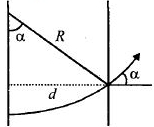
From figure, $sin\,\alpha =dlR$

And we know, $\frac{m v^{2}}{R}=q v B$

$\Rightarrow \quad R=\frac{m v}{q B}$

$\because \sin \alpha=\frac{d q B}{m v}$

$\sin \alpha=B d \sqrt{\frac{q}{2 m V}}\left[\because q V=\frac{1}{2} m v^{2}\right]$

Need a full question paper?

Generate a complete, print-ready paper with questions like this in minutes — across 16+ boards, with answer keys.

Start Generating Free

Similar questions

In producing X-rays a beam of electrons accelerated by a potential difference V is made to strike a metal target. For what value of V, X-rays will have the lowest wavelength of 0.3094 Å
According to Bohr’s theory of $H$ atom, an electron can revolve around a proton indefinitely, if its path is:
Angular magnification of telescope if focal length of objective and eye lenses are $10\, cm$ and $10\, mm$ respectively and tube length is $11\, cm$
Two wires of same size whose resistivities $\rho_1$ are $\rho_2$ and are joined in series. The equivalent resistivity of the combination will be:
A bar magnet is placed north-south with its north pole due north. The points of zero magnetic field will be in which direction from the centre of the magnet
Light of wavelength 4000 Å falls on a photosensitive metal and a negative 2V potential stops the emitted electrons. The work function of the material (in eV) is approximately $(\mathrm{h} = 6.6 \times 10^{-34} \mathrm{Js}, \mathrm{e}=1.6 \times 10^{-19} \mathrm{C}, \mathrm{c}=3 \times 10^8 \mathrm{~ms}^{-1})$
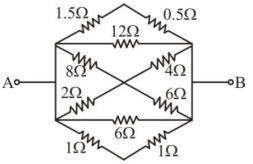
The equivalent resistance between $A$ and $B$ is $......$
Which of the following loop is in stable equallibrium
Four wires of equal length and of resistances 10 ohms each are connected in the form of a square. The equivalent resistance between two opposite corners of the square is
A Daniel cell is balanced on 125 cm length of a potentiometer wire. Now the cell is short-circuited by a resistance 2 ohm and the balance is obtained at 100 cm. The internal resistance of the Daniel cell is