MCQ
A pure semiconductor behaves slightly as a conductor at
  • Room temperature
  • B
    Low temperature
  • C
    High temperature
  • D
    Both $(b)$ and $(c)$ 

Answer

Correct option: A.
Room temperature
a
(a)At room temperature some covalent bond breaks and semiconductor behaves slightly as a conductor.

Need a full question paper?

Generate a complete, print-ready paper with questions like this in minutes — across 16+ boards, with answer keys.
Start Generating Free

Similar questions

Which of the following graphs best represents the motion of a raindrop?
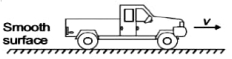
A cart loaded with sand moving with velocity $v$. Sand is falling through the hole as shown in diagram then after falling on the ground sand is
In $CGS$ system, the Young's modulus of a steel wire is $2 \times {10^{12}}$. To double the length of a wire of unit cross-section area, the force required is
A small mass $'m'$ rests at the edge of a horizontal disc of radius $'R'$ . The coefficient of static friction between mass and the disc is $\mu $ . The disc is rotated about its axis at an angular velocity such that the mass slides off the disc and lands on the floor $'h'$ meters below. What was its horizontal distance of travel from the point it left the disc?
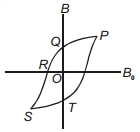
The figure illustrates how $B$, the flux density, inside a sample of ferromagnetic material varies with external magnetic field $B_0$. For the sample to be suitable for making a permanent magnet
A transistor cannot be used as an
When a gas in a closed vessel was heated so as to increase its temperature by ${5^o}C$, there occurred an increase of $1\%$ in its pressure. The original temperature of the gas was ...... $^oC$
The energy of a hydrogen atom in the ground state is $-13.6\,\, eV.$ The energy of the $He^+$ ion in  the first excited state will be....$eV$
Assertion : Lenz's law violates the principle of conservation of energy.

Reason : Induced $emf$ always opposes the change in magnetic flux responsible for its production.

A large horizontal surface moves up and down in $SHM$ with an amplitude of $1 \,cm$. If a mass of $10\, kg$ (which is placed on the surface) is to remain continually in contact with it, the maximum frequency of $S.H.M.$ will be ... $Hz$